
What is positive affirmation? A guide to mental well-being.

Photo by: Viktor Forgacs on Unsplash
Positive affirmation rewires subconscious thoughts and improves mental resilience over time.
Using specific, believable statements consistently enhances self-esteem and reduces stress.
Integrating affirmations with mindfulness and self-care practices boosts emotional well-being.
Positive affirmation gets a bad reputation. Many people write it off as wishful thinking or self-delusion, the kind of thing you mumble in the mirror and forget by noon. But the science tells a different story. Research consistently shows that intentional, belief-based affirmations can reshape how your brain processes stress, self-worth, and emotional challenges. They are not a magic fix, but when used correctly, they are a genuinely powerful tool. This guide walks you through what positive affirmations really are, how they work, and exactly how to apply them to support your mental and emotional well-being.
Table of Contents
Key Takeaways
Point | Details |
True definition | A positive affirmation is a specific, positive phrase used to shift unhelpful thoughts into supportive ones. |
Mental health benefits | Affirmations can reduce stress, boost resilience, and support emotional well-being when used correctly. |
Application matters | Affirmations are most effective when they feel believable, are repeated consistently, and are used alongside self-care routines. |
Holistic integration | Combining affirmations with mindfulness, silence, and time in nature amplifies their positive effects. |
Understanding positive affirmation: Definition and core principles
Let’s start by laying the groundwork with a clear description of positive affirmations and how they truly function.
A positive affirmation is a specific, intentional statement designed to challenge and replace self-sabotaging or limiting thoughts. Think of it as a mental reset button. When your inner voice says “I’m not good enough,” an affirmation steps in with a counter-narrative rooted in truth and intention. Positive affirmations alter subconscious beliefs and build self-worth over time, not overnight.
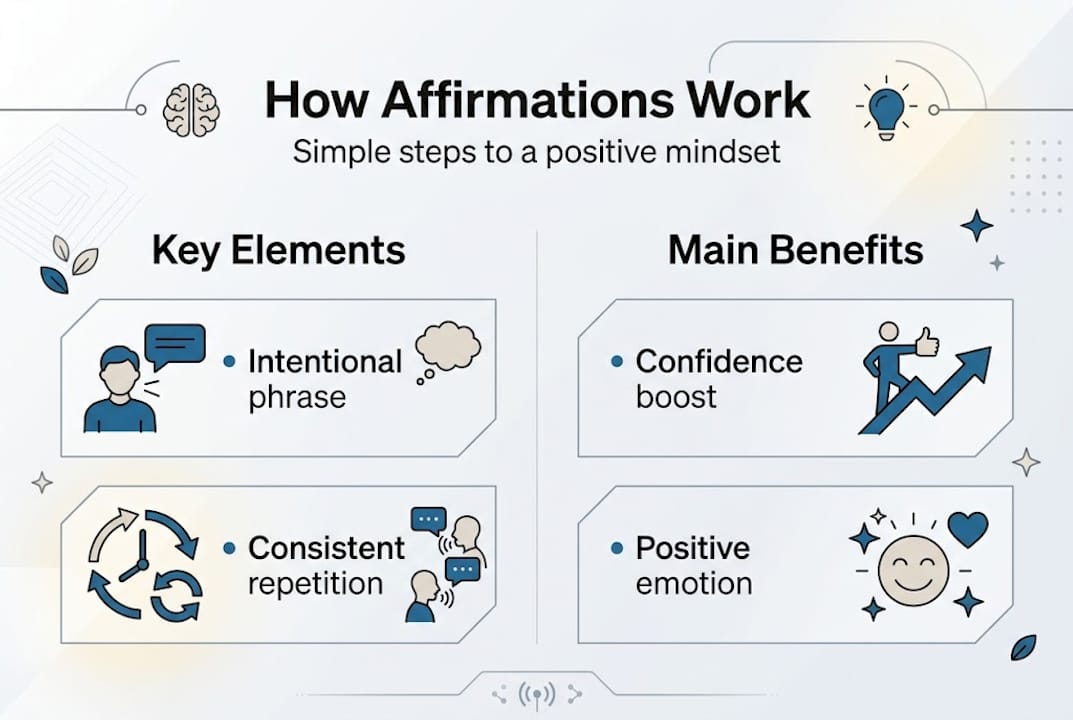
Affirmations work by influencing subconscious thinking patterns. Repeated consistently, they begin to shift the emotional lens through which you interpret your experiences. This is not fantasy. It is a form of cognitive restructuring, where you deliberately redirect your thought patterns toward more supportive beliefs.
Here is where many people get confused: affirmations are not the same as toxic positivity and alternatives. Toxic positivity means dismissing genuine pain with forced cheerfulness. Affirmations, done right, acknowledge reality while gently steering your mindset toward growth and possibility.
Core principles of effective affirmations:
Present tense: State affirmations as if they are already true.
Personal relevance: Choose statements that connect to your real goals and values.
Positivity: Frame statements around what you want, not what you want to avoid.
Believability: Start with statements that feel at least partially true.
Some examples:
Effective affirmation | Weak affirmation |
I am growing stronger every day | I am perfect and have no flaws |
I handle challenges with calm | Nothing bad ever happens to me |
I am worthy of love and care | Everyone loves me all the time |
“Affirmations are not about pretending life is perfect. They are about training your mind to notice your strengths and possibilities, even in difficult moments.”
The goal is not to lie to yourself. It is to offer your mind a more balanced, empowering perspective.
How positive affirmation impacts mental and emotional health
With a solid understanding of what affirmations are, let’s examine how they impact your mental and emotional well-being.
The research here is encouraging. A positive mental attitude is directly linked to better overall well-being and reduced stress. When you practice affirmations regularly, you are essentially training your nervous system to respond to challenges with greater resilience rather than panic or shutdown.

Photo by: Guillaume de Germain on Unsplash
Studies show that self-affirmation activates the brain’s reward centers, creating a ripple effect across mood, motivation, and behavior. This is not a vague claim. Brain imaging research has shown that affirmation practices engage the ventromedial prefrontal cortex, the area associated with self-related processing and positive valuation. In plain terms: your brain literally lights up in a healthier way.
Emotional benefits of regular affirmation practice:
Reduced anxiety and stress responses
Improved self-esteem and confidence
Greater emotional resilience in difficult situations
Increased motivation to pursue meaningful goals
A stronger sense of identity and self-worth
Better ability to manage negative self-talk
Combining affirmations with mindfulness and mental health practices amplifies these results significantly. Mindfulness creates the mental stillness needed for affirmations to land deeply, rather than bouncing off a distracted or overwhelmed mind.
Pro Tip: Say your affirmations during a brief mindful pause, like right after a few slow, deep breaths. This primes your nervous system to receive the message rather than resist it.
The emotional benefits build gradually, like compound interest for your mindset. Small, consistent deposits create significant change over weeks and months.
Applying positive affirmation: Practical steps and examples
Understanding the benefits, the next step is learning how to craft and apply affirmations in your daily life.
Effective affirmations are specific, believable, and directly relevant to your current goals. Generic statements like “I am happy” often feel hollow. A statement like “I am learning to trust myself more each day” feels real and achievable.
Step-by-step process for daily affirmation practice:
Identify a limiting belief. What negative thought keeps surfacing? Name it clearly.
Write a counter-statement. Craft a present-tense, positive response to that belief.
Check for believability. If it feels completely false, soften it. “I am becoming” works better than “I am already.”
Choose a consistent time. Morning routines, bedtime, or post-meditation are ideal windows.
Say it with intention. Speak or write it slowly, focusing on the meaning, not just the words.
Repeat daily for at least 30 days. Consistency is what creates the shift.
Positive affirmations by goal:
Confidence: "I trust my ability to figure things out."
Stress management: "I breathe through challenges and return to calm."
Self-acceptance: "I am enough exactly as I am right now."
Resilience: "I have overcome hard things before, and I can do it again."
Some examples:
Effective affirmation | Ineffective affirmation |
I am learning to love myself | I love everything about myself |
I welcome abundance into my life | I am a millionaire |
I face fear with courage | I am never afraid |
Pro Tip: Stack your affirmations with existing self-care routines like brushing your teeth or making coffee. Habit stacking dramatically increases follow-through because you attach the new behavior to something already automatic.
Avoid the common beginner mistake of rushing through affirmations on autopilot. Speed kills the effect. Slow down, breathe, and mean it.
Integrating affirmation with holistic self-care and mindfulness
Once you have a solid affirmation practice, amplifying its power comes from integrating it with holistic wellness routines.
Affirmations work best when they are part of a larger ecosystem of self-care. Isolated, they are helpful. Woven into a broader wellness lifestyle, they become transformative. Self-care for wellness supports emotional strength, and affirmations are one of the most accessible and powerful components of that foundation.
Ways to integrate affirmations into your holistic wellness routine:
Pair affirmations with a morning meditation session to set an intentional tone for the day
Write affirmations in a gratitude or mindfulness journal to reinforce positive neural pathways
Use affirmations during yoga or gentle movement to anchor the mind-body connection
Repeat a calming affirmation during stressful moments as a grounding technique
Combine affirmations with nature and mental health practices, like speaking them during a walk outside
Use silence and inner clarity practices to create mental space before your affirmation practice
Research supports the value of these combinations. Time in nature, for example, has an 80% effect size on mental health improvement, making it one of the most potent backdrops for affirmation work.
“When you combine affirmations with mindfulness, movement, and time in nature, you are not just thinking differently. You are creating the biological conditions for genuine emotional change.”
The synergy here is real. Meditation quiets the mental noise. Nature reduces cortisol. Silence creates receptivity. Affirmations then have a clear channel to reach deeper layers of belief and emotional patterning. Think of each practice as preparing the soil so the affirmation seed can actually take root.
Why positive affirmation isn't just positive thinking: What most guides miss
After integrating affirmations with holistic practices, it is important to consider when they work and when they might not.
Here is the honest truth most affirmation guides skip: blind repetition without genuine belief can actually backfire. If you repeat “I am confident” while feeling deeply unworthy, the gap between the statement and your felt reality can increase frustration rather than reduce it. The affirmation becomes a reminder of how far you feel from where you want to be.
This is where where affirmations can go wrong overlaps with toxic positivity. Using affirmations as a shield to avoid processing real emotions is a misuse of the tool. Real growth requires you to feel what is there, not paper over it.
The most effective approach blends affirmations with honest self-reflection. Acknowledge the hard feeling first. Then offer the affirmation as a gentle redirect, not a denial. “This is difficult, and I am also capable of getting through it” is far more powerful than pretending the difficulty does not exist.
We believe affirmations are most transformative when they are grounded in self-awareness, not escapism. Use them to build toward truth, not away from it. That distinction is what separates a healthy practice from one that quietly reinforces avoidance.
Find support for your affirmation journey
If you are ready to take the next step or need more guidance, you are not alone and support is available.
Building a meaningful affirmation practice takes time, and having the right resources alongside you makes a real difference. At Life So Well, we are committed to helping you navigate your mental and emotional well-being with practical, evidence-informed guidance.

Photo by: Kelly Sikkema on Unsplash
Explore our emotional wellness resources to find articles, tools, and practices that complement your affirmation work. Whether you are just starting out or deepening an existing practice, the Life So Well community is here to walk alongside you. Your well-being journey deserves consistent, compassionate support, and we are glad to be part of it.


Comments