
What is the wellness wheel? A guide to holistic health
- teamlifesowell
- 9 hours ago
- 8 min read

TL;DR:
The wellness wheel visually maps various life areas that influence holistic health.
Models differ in focus and validation, so choose one adaptable to your life.
Use the wheel as a flexible tool for honest self-assessment and small, focused growth actions.
Wellness is not about having every part of your life running perfectly at the same time. That idea is one of the most common myths in the self-care space, and it can leave you feeling like you’re always falling short. The truth is, holistic health is messy, dynamic, and personal. The wellness wheel offers a realistic, structured way to see the full picture of your wellbeing, and to act on it without chasing impossible perfection. This article breaks down what the wellness wheel is, how its models differ, how to use it for real growth, and what its honest limits are.
Table of Contents
Key Takeaways
Point | Details |
Wellness wheel explained | The wellness wheel is a simple framework that organizes holistic wellbeing into multiple connected dimensions. |
Models differ | Different wellness wheel models focus on different areas and offer varying strengths and weaknesses. |
Progress over perfection | Wellness is about small, meaningful steps across life’s dimensions, not seeking perfect balance. |
Practical application | You can use the wheel to reflect, set goals, and combine actions for greater wellbeing. |
Limits exist | The wellness wheel is a guide, not a universal solution, and should be adapted to what works best for you. |
What is the wellness wheel?
Now that we’ve set aside the myth of perfect balance, let’s clarify what the wellness wheel actually is and why it’s such a useful tool.
At its core, the wellness wheel is a circular diagram that maps out different areas of your life that contribute to your overall health. Think of it like a pie chart for your wellbeing, where each slice represents a dimension of your life, from your physical health to your relationships to your sense of purpose. When you can see all the pieces laid out visually, it becomes much easier to spot where you’re thriving and where you might need a little more attention.
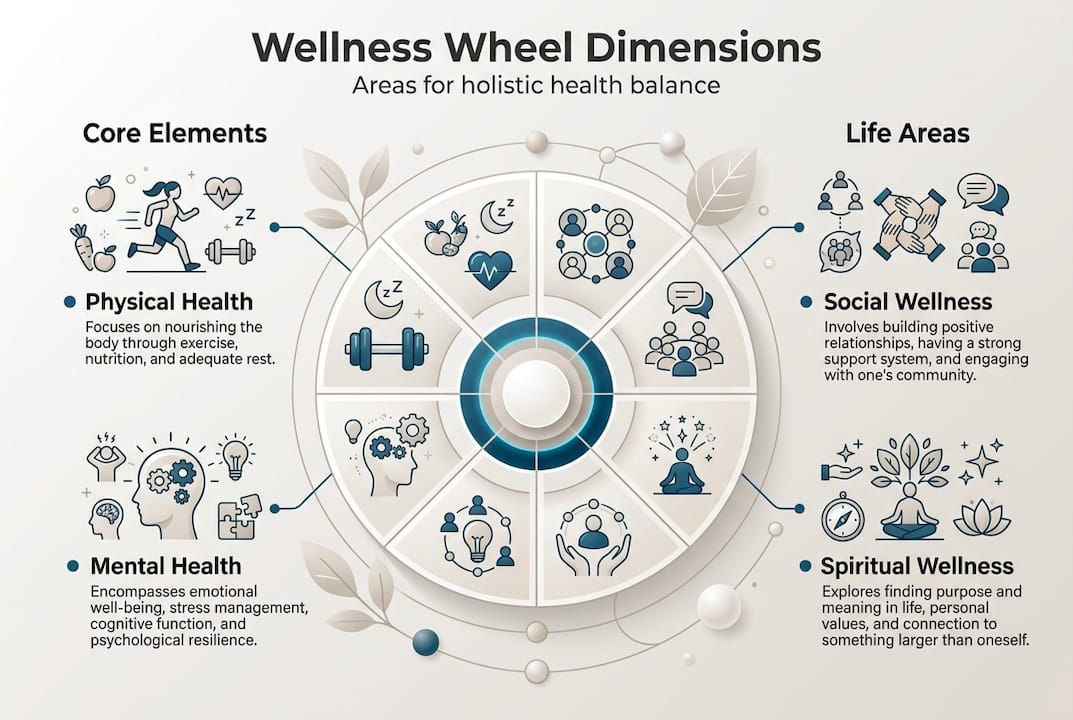
The science behind the wellness wheel traces back to Dr. Bill Hettler, who co-founded the National Wellness Institute and developed the Six Dimensions of Wellness model in the 1970s. This model was groundbreaking because it moved wellness beyond just physical health and recognized that emotional, intellectual, social, occupational, and spiritual factors all shape how well you feel. The wellness wheel is a visual framework representing multiple interconnected dimensions of holistic wellness, originally developed by Dr. Bill Hettler in the 1970s as part of the National Wellness Institute’s Six Dimensions of Wellness model.
Here’s a quick look at the typical dimensions you’ll find in most wellness wheel models:
Dimension | What it covers |
Emotional | Managing feelings, resilience, self-awareness |
Physical | Exercise, sleep, nutrition, body care |
Intellectual | Learning, curiosity, creative thinking |
Social | Relationships, community, communication |
Spiritual | Purpose, values, meaning in life |
Occupational | Career satisfaction, work-life balance |
Environmental | Connection to surroundings, safety, sustainability |
Financial | Money management, security, future planning |
No dimension operates in isolation. If your sleep is suffering (physical), your mood tends to drop (emotional), and your motivation at work fades (occupational). This is the ripple effect the wheel makes visible.
Wellness is not a destination you reach when all dimensions are in perfect order. It’s an ongoing process of recognizing where you are and choosing actions that move you forward, one step at a time.
Building a balanced lifestyle for mental wellness starts with this kind of awareness. The wellness wheel gives you the map to begin.

How models differ: Beyond one-size-fits-all
Now that you know the basics, it’s important to realize not all wellness wheels work the same way.
Several models have emerged over the decades, each with a different philosophy and focus. Some place spirituality at the center. Some add dimensions for environmental or financial health. Others are designed with specific populations in mind. Understanding these differences helps you choose the model that actually fits your life.
Here’s a comparison of the major models:
Model | Developer | Dimensions | Key focus |
Six Dimensions | Dr. Bill Hettler (1976) | 6 | Occupational, intellectual, social, physical, spiritual, emotional |
Wheel of Wellness | Witmer & Sweeney (1998) | 5 life tasks | Spirituality at center, counseling-based |
Multidimensional Wheel | Travis (1977) | 12 | Breadth and lifestyle depth |
Consensus Model | Multiple authors | Varies | Broad but lacks research validation |
Variations exist across these frameworks: Witmer & Sweeney’s Wheel of Wellness centers spirituality with 5 life tasks, Travis’ Multidimensional Wheel includes 12 processes, and some models specifically emphasize women’s health nuances or lack formal validation. That’s a meaningful distinction when you’re deciding which framework to trust.
Not every model has been rigorously tested. Research validation gaps exist across wellness wheel models, with some validated through structural equation modeling while others, like the Consensus Model, remain unvalidated and show cultural and gender-specific blind spots. In other words, a model might look thorough on paper but still miss what matters most to you.
When should you adapt a model versus follow it strictly? Here’s a practical guide:
Follow it strictly when you’re new to wellness reflection and need a clear starting structure
Adapt the model when a dimension doesn’t apply to your cultural background or life stage
Blend models if one speaks to your spiritual side and another covers financial wellness better
Add your own dimension if something central to your life (like caregiving or creative expression) isn’t represented
Reassess annually because what fits at 25 may not serve you at 45
Exploring wellness habits for balanced living can help you figure out which dimensions deserve the most attention in your current season of life.
How to use the wellness wheel for personal growth
Understanding the different models sets up how you can use the wheel yourself.
The wellness wheel is only useful if you actually apply it. The good news is, you don’t need a therapist or a formal assessment to get started. You just need honesty, a little time, and a willingness to look at your life without judgment.
Here’s a simple step-by-step process:
Print or draw the wheel. Sketch a circle and divide it into your chosen dimensions (six to eight works well for most people).
Rate each dimension. On a scale of 1 to 10, score your current satisfaction in each area. Be honest, not aspirational.
Look for patterns. Which areas are thriving? Which feel neglected? Notice if any low-scoring dimensions seem connected.
Choose one or two focus areas. Don’t try to fix everything at once. Pick the dimension where a small improvement would create the biggest ripple.
Set one small, specific goal. Instead of “exercise more,” try “walk for 20 minutes three times a week.”
Revisit in 30 days. Reassess and adjust as needed. Progress compounds over time.
The wellness wheel is subjective and flexible, and perfect balance is unrealistic. What matters is focusing on personal strengths and taking small, synergistic actions, like walking with a friend, which simultaneously supports your physical and social dimensions.
Thinking about self-care’s role in wellness can help you identify which actions give you the most return across multiple dimensions.
Pro Tip: Look for actions that serve two or more dimensions at once. Cooking a new recipe with a partner touches physical (nutrition), social (connection), and even intellectual (learning) wellness at the same time. These “multi-dimension” habits are your biggest leverage points.
Aim for progress, not perfection. The wheel is not a report card. It’s a compass.
The benefits and limits of the wellness wheel
Bringing the wellness wheel into your life is powerful, but it’s essential to know its strengths and weaknesses.
One of the biggest benefits of the wellness wheel is how it builds self-awareness. When you can see all your wellness dimensions laid out visually, you naturally start thinking more holistically about your choices. That extra hour of sleep isn’t just a physical win. It’s also an emotional reset and a productivity boost.
Here are the key benefits:
Structured reflection: Gives you a consistent framework to check in with yourself regularly
Visualization: Makes abstract concepts like “wellbeing” concrete and easy to act on
Holistic perspective: Reminds you that health is not just about the gym or eating clean
Goal clarity: Helps you prioritize which areas need attention without overwhelming yourself
Flexibility: Most models allow you to tailor dimensions to your own life and values
Despite these strengths, the wellness wheel has real limitations. Multiple wellness wheel models exist with varying structures, and some place spirituality at the center while others add dimensions around women’s health nuances or lack research validation entirely. That means using a poorly validated model could give you a skewed picture of your wellbeing.
The wheel is also sometimes criticized for encouraging a “checklist mindset,” where you focus on ticking boxes rather than genuinely experiencing growth. It can feel reductive when life’s complexity doesn’t fit neatly into six or eight slices.
Pro Tip: Use the wellness wheel as a guide, not a rigid rulebook. If a dimension doesn’t resonate with your values or background, swap it out for something that does. The wheel serves you, not the other way around.
Social wellness is often underestimated in these frameworks. Strengthening your relationships can have a powerful domino effect across nearly every other dimension of the wheel.
Remember, progress matters far more than perfection here. A person who consistently improves two dimensions with intention will always outpace someone chasing symmetry across all eight.
Our take: The wellness wheel is a map, not the whole journey
With the benefits and limits in mind, it’s time for a fresh, experience-based perspective.
Most wellness content tells you to “find balance.” We think that advice, while well-meaning, sets people up for quiet frustration. Balance implies a static state. Real life is not static. Your needs shift with seasons, relationships, stress, and age. The wellness wheel is most powerful when you treat it as a map rather than a destination.
What most guides overlook is that your strongest dimensions can carry your weaker ones. If your social wellness is vibrant, lean on it. Meet a friend for a walk and you’ve quietly addressed three other dimensions without a plan. That’s the compounding effect of building wellness habits through strength and synergy, not willpower and symmetry.
Flexibility is not a compromise. It’s the actual strategy. Start where you are, focus on what moves the needle most for you, and trust that consistent small steps create meaningful, lasting change.
Enhance your wellness journey with Life So Well
Ready to keep growing? Here’s how you can take your next steps to holistic wellness.
If the wellness wheel has sparked something in you, there’s a whole world of guidance waiting at Life So Well. The platform offers articles, workflows, and practical tips designed to help you build a holistic lifestyle that actually fits your real life, not an idealized version of it.

Whether you’re just starting to explore your wellness dimensions or you’re ready to build consistent habits, you’ll find clear, actionable guidance through the wellness habits workflow guide. Think of it as your next step after the wheel: turning self-awareness into daily action that sticks.
Frequently asked questions
How many dimensions are in the wellness wheel?
Most commonly, wellness wheels feature six to eight dimensions, but some models include up to twelve, depending on the framework. For example, Travis’ Multidimensional Wheel includes 12 processes, while Witmer & Sweeney’s model organizes wellness into 5 life tasks.
Is the wellness wheel backed by research?
Some models are more evidence-based than others. The Wheel of Wellness by Witmer & Sweeney has been validated with strong fit metrics like an RMSEA of 0.042, while other models, such as the Consensus Model, have not been formally validated.
Can the wellness wheel be customized?
Yes, absolutely. The wheel is subjective and flexible by design, so you can add, remove, or rename dimensions to better reflect your personal values, cultural background, or life stage.
How do I get started using a wellness wheel?
Start by rating your satisfaction in each dimension on a scale of 1 to 10, then identify your strongest and weakest areas. From there, set one small, specific goal in a focus area and reassess your progress every few weeks.
Recommended
Comments