
What Is Mindfulness? A Practical Guide to Calm and Clarity

TL;DR:
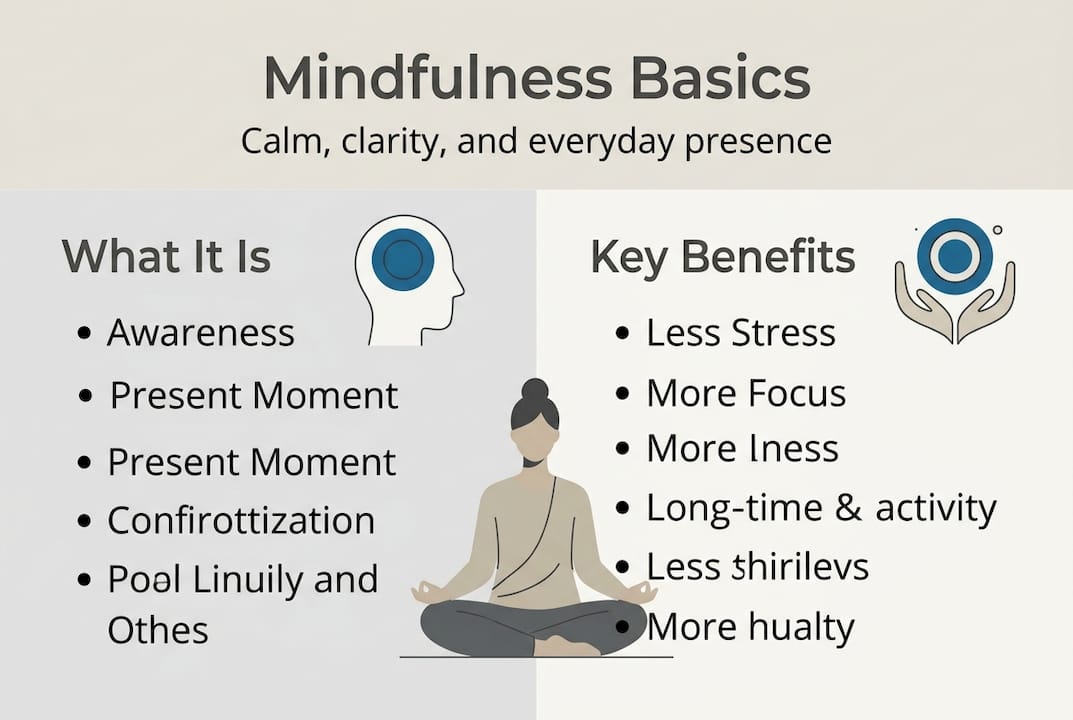
Mindfulness is a quality of attention, not just meditation, focusing on present-moment awareness.
Regular mindfulness practice improves emotional regulation, reduces stress, and builds lasting mental resilience.
Even brief, consistent moments of mindfulness in daily life can lead to significant mental health benefits.
Mindfulness gets tossed around so often that it has started to lose its meaning. Some people picture a monk sitting cross-legged on a mountain. Others assume it is just a trendy word for relaxing. But mindfulness is something far more specific and far more powerful than either image suggests. Meta-analyses show moderate effects on stress reduction, anxiety, and depression, with a standardized mean difference of -0.53 for stress outcomes. That is a measurable, real-world impact. This guide will walk you through what mindfulness actually is, how it works in your brain, what myths to drop, and how to build it into your everyday life starting today.
Table of Contents
Key Takeaways
Point | Details |
Mindfulness is awareness | It means observing your present moment experiences with curiosity and without judgment. |
It’s not just meditation | Mindfulness can be practiced throughout daily life, not only during meditation. |
Practical benefits are real | Studies show mindfulness supports stress reduction and emotional regulation. |
Consistency matters | Regular short practices yield meaningful results over time. |
Defining mindfulness: More than meditation
Most people use mindfulness and meditation interchangeably. That is the first thing worth correcting. Mindfulness is a quality of attention, not a specific activity. The widely cited definition, originally shaped by researcher Jon Kabat-Zinn, describes it as paying attention on purpose, in the present moment, and non-judgmentally. Meditation is one structured method to train that quality of attention. But you can also be mindful while washing dishes, walking to your car, or listening to a friend.
The definitions vary considerably depending on the framework being used. Some experts emphasize attention and awareness. Others center acceptance and non-reactivity. Still others highlight compassion as a core element. Secular adaptations, like Mindfulness-Based Stress Reduction (MBSR), strip away the Buddhist ethical framework while preserving the attention-training techniques. This is why you will hear the word used differently in a clinical setting versus a meditation retreat.
Here is a quick comparison of how mindfulness shows up across different contexts:
Context | Focus | Example practice |
Clinical (MBSR) | Stress and symptom reduction | Body scan, breath awareness |
Workplace programs | Focus and productivity | Mindful pauses between tasks |
Traditional Buddhist | Ethics, compassion, liberation | Formal sitting meditation |
Daily self-care | Emotional regulation | Mindful eating, walking |
Understanding these distinctions matters because it shapes how you approach your own practice. If you have tried meditation and found it frustrating, you have not necessarily tried mindfulness in its full form. The benefits for mental health extend well beyond what happens on a meditation cushion.
“Mindfulness means paying attention in a particular way: on purpose, in the present moment, and non-judgmentally.” — Jon Kabat-Zinn
Think of mindfulness less as a practice you do and more as a lens you learn to look through. Once you shift that frame, the possibilities for integrating it into daily life open up considerably.
How mindfulness works in the brain and emotions
With a clearer definition of mindfulness, let’s explore how it actually affects the mind and emotions. The changes are not mystical. They are grounded in how your brain processes thoughts and feelings.
The core mechanism is metacognition, which simply means thinking about your thinking. When you practice mindfulness, you start to notice your thoughts as events passing through your mind rather than absolute truths. That small shift is enormous. Instead of being swept away by a wave of anxiety, you observe it. “There is anxiety here.” That tiny gap between experience and reaction is where emotional regulation lives.

Mechanisms involve metacognitive changes, reduced rumination and worry, and improved emotional regulation through non-judgmental awareness. Rumination is the mental loop where you replay a stressful situation over and over. Mindfulness interrupts that loop by redirecting attention to the present moment. Worry, which is future-focused, loses its grip when you anchor your awareness to what is happening right now.
Here is how mindfulness compares to common coping patterns:
Approach | Effect on emotions | Sustainability |
Avoidance | Short-term relief, long-term buildup | Low |
Distraction | Temporary, does not resolve root issue | Low to moderate |
Mindfulness | Processes emotions without amplifying them | High |
Rumination | Intensifies negative emotions | Very low |
The benefits for emotional balance and stability build gradually. You do not flip a switch. You train a skill. And like any skill, the more you practice, the more naturally it shows up when you need it most, especially during stressful moments.
Key emotional shifts you can expect with consistent mindfulness practice:
Reduced reactivity to minor frustrations
Greater ability to pause before responding in conflict
Improved tolerance for uncomfortable emotions
Stronger sense of emotional stability during uncertainty
More frequent moments of genuine calm throughout the day
Pro Tip: When you feel a strong emotion rising, try naming it silently. “This is frustration.” “This is worry.” Naming activates the prefrontal cortex and naturally reduces the emotional charge, a simple metacognitive move you can use anywhere.
Common misconceptions and expert nuances
With the mechanics covered, it is equally important to address common myths and subtle nuances that can impact your mindfulness journey.
Myth 1: Mindfulness is always relaxing. Not true. Sometimes sitting with your thoughts brings up discomfort. That is not a sign you are doing it wrong. It is a sign it is working.
Myth 2: You need to clear your mind. The goal is not a blank mind. The goal is to notice when your mind wanders and gently bring it back. Wandering is normal. Returning is the practice.
Myth 3: A few mindful moments are enough. Research tells a more nuanced story. Daily practice enhances benefits over dispositional traits alone. In other words, how often you practice matters more than how naturally mindful you are.
Myth 4: Mindfulness suits everyone equally. For most people, it is a safe and beneficial tool. But for those experiencing acute trauma, diving into unguided mindfulness can sometimes surface overwhelming material. Professional support is important in those cases.
Important nuances to keep in mind:
Accepting emotions tends to produce longer-lasting benefits than technique alone
Mindfulness is not a replacement for therapy or medical treatment
The quality of your attention matters more than the length of your session
Combining mindfulness with other stress management tips amplifies results
Consistency over weeks and months is what drives lasting change
A key insight from the research: accepting what you feel, rather than trying to change or suppress it, is one of the most powerful things mindfulness teaches. That acceptance is not passive. It is an active, courageous act of turning toward your experience instead of away from it.
Pro Tip: If you are new to mindfulness and have a history of trauma, start with grounding techniques like the 5-4-3-2-1 sensory exercise before moving into open awareness practices. The role of self-care in building that foundation cannot be overstated.
Statistic to know: Meta-analyses report a standardized mean difference of -0.53 for stress reduction with mindfulness interventions, a moderate and clinically meaningful effect that holds across diverse populations.
Applying mindfulness in daily life: Simple practices
After debunking misconceptions, you are ready for practical steps to bring mindfulness into real life. The good news is that you do not need a special room, a meditation app, or an hour of free time. You need a few minutes and a willingness to pay attention.
Here are five simple ways to start building mindfulness into your day:
Mindful breathing (1-3 minutes). Sit comfortably, close your eyes, and focus entirely on your breath. Notice the sensation of air entering and leaving. When your mind drifts, gently return. That returning is the core skill.
Mindful eating. At one meal today, put your phone away. Notice the color, texture, and taste of your food. Eat slowly. This is practicing mindful living in one of its most accessible forms.
Mindful walking. On your next short walk, leave the earbuds out. Feel your feet on the ground. Notice what you see, hear, and smell. Five minutes of this can reset your nervous system.
Transition pauses. Before switching tasks at work or home, take three conscious breaths. This brief pause trains your brain to be present rather than reactive.
Body scan before sleep. Spend two to five minutes mentally scanning from your feet to your head, noticing any tension without trying to fix it. This builds body awareness and supports better sleep.
Moderate effects on stress appear in research even with brief, consistent practice. You do not need long sessions to see results. What matters is showing up regularly. Pairing these practices with your existing balanced lifestyle tips creates a natural rhythm that is easier to sustain.
Pro Tip: Anchor a new mindfulness habit to something you already do every day, like making coffee or brushing your teeth. Habit stacking makes consistency far easier than relying on motivation alone.
Why mindfulness matters more than ever and what most guides miss
Most mindfulness content online paints a serene picture: soft lighting, a quiet room, a perfectly still mind. That image is not wrong, but it is incomplete, and for many people it creates a quiet sense of failure before they even begin.
The truth is that mindfulness thrives in messiness. It was built for real life, not ideal conditions. A five-minute practice squeezed between school drop-off and a work call counts. A moment of conscious breathing during a tense conversation counts. Imperfect engagement with the present moment is still engagement.
What most guides also miss is that the real-life benefits of mindfulness come from accumulation, not from any single perfect session. Small, consistent moments of awareness add up over days and weeks into a genuinely different relationship with your thoughts and emotions. You do not need to meditate for an hour. You need to show up, imperfectly, again and again. That is where the real shift happens.
Explore more resources to support emotional well-being
If this guide sparked something for you, there is much more to explore. Understanding mindfulness is a starting point, but applying it consistently is where the real change unfolds.

At Life So Well, we have built a growing library of articles, guides, and practical tools designed to support your mental and emotional health at every stage. Whether you are just beginning or deepening an existing practice, our emotional health resources cover everything from stress relief techniques to emotional resilience strategies. Explore what resonates with you, and remember that every small step toward well-being is worth taking. You do not have to figure this out alone.
Frequently asked questions
Is mindfulness the same as meditation?
No, meditation is one structured way to practice mindfulness, but mindfulness refers to a present-moment awareness you can cultivate both in and out of formal meditation sessions.
How quickly will I see the benefits of mindfulness?
You may notice reduced stress within a few weeks of consistent practice. Meta-analyses confirm that benefits grow over months of regular engagement rather than appearing overnight.
Is mindfulness suitable for everyone?
Most people can benefit safely, but those experiencing acute trauma should seek professional support first, since unguided practice can sometimes surface difficult material without the right framework in place.
What is the simplest way to try mindfulness today?
Focus on your breath for one minute, noticing each inhale and exhale, and gently return your attention whenever your mind wanders. That single minute is a complete mindfulness practice.
Recommended


Comments