
Be true to yourself: unlock genuine confidence and well-being

TL;DR:
Authenticity involves aligning inner values, feelings, and outward behaviors, enhancing well-being.
Practicing authenticity leads to better mental health, deeper relationships, and increased resilience.
Obstacles include social pressure, cultural norms, fear of judgment, and emotional discomfort.
Many people spend years trying to fit in, believing that social acceptance is the fastest route to happiness. Yet the opposite turns out to be true. Authenticity links to better mental health, higher self-esteem, and more satisfying relationships, according to recent empirical research. Being true to yourself is not a feel-good slogan. It is a measurable psychological state with real consequences for how you feel, how you connect with others, and how resilient you become when life gets hard. This article walks you through what authenticity actually means, why it matters so deeply, the genuine obstacles you will face, and the practical steps you can take to start living more authentically today.
Table of Contents
Key Takeaways
Point | Details |
Authenticity boosts well-being | Being true to yourself leads to better mental health and deeper relationships. |
Obstacles are real | Social pressures and power dynamics can make authenticity challenging, but not impossible. |
Practical steps matter | Building simple habits like mindfulness and self-reflection fosters authentic living. |
Self-acceptance over perfection | Authenticity means embracing your real self, not always aiming for flawlessness. |
What does it mean to be true to yourself?
Authenticity is one of those words that gets used constantly but rarely defined well. At its core, authenticity means alignment: your inner values, your emotional experiences, and your outward behaviors are pointing in the same direction. When you act in ways that contradict what you genuinely believe or feel, a kind of internal friction builds up. Over time, that friction erodes well-being.
Here is where a common misconception trips people up. Being authentic does not mean saying every thought out loud or refusing to adapt to social situations. It is not bluntness dressed up as honesty, and it is certainly not an excuse for selfishness. Real authenticity is thoughtful. It involves knowing yourself well enough to make conscious choices about what you share, how you behave, and why.
A study involving over 400 participants found a strong link between self-awareness and authenticity, demonstrating that people who understand their internal emotional states are significantly more likely to live in ways that feel genuine. This matters because self-awareness is a skill you can build, not a fixed trait.
“Authenticity is strongly correlated with mental well-being and increased self-esteem in young adults, reinforcing the importance of internal state awareness as a foundation for genuine living.”
Authentic people tend to share several recognizable qualities:
They acknowledge uncomfortable emotions rather than suppressing them
They make decisions based on personal values, not just social pressure
They can disagree without becoming defensive or dismissive
They take responsibility for their actions without excessive self-criticism
They maintain consistency between their private and public selves
One particularly damaging pattern is what researchers call “surface acting,” where you perform emotions you do not feel in order to meet social expectations. Think of smiling through situations that genuinely distress you. Surface acting drains emotional energy fast and is linked to burnout and reduced well-being. Understanding the benefits of self-care becomes even more relevant here, since self-care rituals create the internal space needed to recognize and honor your genuine emotional state. Cultivating positive mental attitudes also supports this process by building the cognitive foundation that makes self-awareness easier to sustain.
Why authenticity boosts mental health and relationships
With a clear definition in mind, it is worth exploring why authenticity delivers such consistent psychological payoffs. The research is persuasive. Those who embrace authenticity experience better mental health outcomes and more satisfying relationships compared to those who chronically mask or suppress their true selves.

Here is a quick look at how authenticity maps onto specific outcomes:
Outcome area | Effect of high authenticity | Effect of low authenticity |
Mental health | Lower anxiety, reduced depression risk | Higher stress, emotional fatigue |
Self-esteem | Stable, internally grounded | Fragile, approval-dependent |
Relationships | Deeper trust and connection | Surface-level, high maintenance |
Life satisfaction | Consistently higher ratings | Fluctuates with external validation |
Emotional resilience | Faster recovery from setbacks | Slower, more reactive |
The benefits are not abstract. Living authentically tends to produce very practical improvements:
Reduced stress: You spend less energy managing conflicting self-presentations
Greater resilience: When challenges arise, a grounded sense of self acts as an anchor
Healthier relationships: People who know your real self can actually support you
Clearer decision-making: Values-based choices feel more coherent and easier to stand behind
More consistent energy: Authenticity removes the emotional drain of constant performance
The ripple effect on relationships is especially significant. When you show up genuinely, you invite others to do the same. This creates a positive cycle where mutual honesty builds trust, and trust deepens connection. Understanding social stress and relationships reveals how much of our day-to-day anxiety is rooted in relational inauthenticity. Building authentic social connections is one of the most protective factors for long-term mental health.
Pro Tip: You do not need dramatic gestures to build authentic habits. Sharing one genuine opinion per day, or expressing a feeling you would normally hide, gradually rewires how you relate to yourself and others. Mindful authenticity through regular mindfulness practice helps you notice the gap between what you feel and what you perform, which is the first step to closing it.
Common obstacles and the complexity of authenticity
Knowing the benefits is only part of the story. The honest truth is that being authentic is genuinely hard, and not always equally available to everyone. Recognizing the real obstacles helps you approach the practice with compassion rather than frustration.
Some of the most common barriers include:
Social conformity pressure: Workplaces, families, and social groups reward fitting in, often punishing deviation from the norm
Cultural expectations: Many cultures prioritize collective harmony over individual expression, making personal authenticity feel disrespectful or disruptive
Fear of judgment: The fear that showing your true self will lead to rejection keeps many people locked in performance mode
Identity uncertainty: If you are still figuring out your values, authenticity is difficult to anchor
Emotional avoidance: Authenticity requires facing uncomfortable feelings, which many people are understandably reluctant to do
There is also a structural dimension that is rarely acknowledged in wellness conversations. Research acknowledges that free will belief mediates the relationship between self-awareness and authenticity, and that not everyone has equal freedom to express their true selves due to power dynamics, economic vulnerability, and systemic pressures.
“Authenticity is a privilege that varies significantly depending on social position. Someone in a precarious economic situation cannot always afford the risk of full self-expression at work, and acknowledging this prevents the wellness conversation from becoming tone-deaf.”
This does not mean giving up. It means practicing authenticity where you safely can, and extending self-compassion in contexts where full expression is genuinely risky. Be cautious of advice that pushes relentless positivity without acknowledging real constraints. Recognizing signs of toxic positivity helps you distinguish between genuine encouragement and pressure to perform wellness.
Pro Tip: Authenticity is not a destination you arrive at all at once. Think of it as a gradual expansion. Each small, honest choice widens your capacity for genuine living over time. Progress, not perfection, is the actual goal.
Practical habits to nurture your authentic self
Despite the challenges, practical habits can genuinely shift how authentically you live each day. The key is building routines that increase internal awareness and create small, consistent opportunities to act in alignment with your values.
Here are four evidence-supported steps to get started:
Daily journaling: Write for 10 minutes each morning about how you are actually feeling versus how you are presenting yourself to the world. This gap awareness is where growth begins.
Mindfulness practice: Regular mindfulness strengthens the ability to observe your thoughts and emotions without immediately reacting to them, giving you space to respond authentically. Internal state awareness is positively associated with authenticity, especially when supported by self-reflective practices like this.
Values clarification: Write down your top five personal values. Review daily decisions against that list. When choices conflict with your values, that tension is important data.
Seeking honest feedback: Ask someone you trust to reflect back what they observe about you. External perspective often reveals blind spots that internal reflection misses.
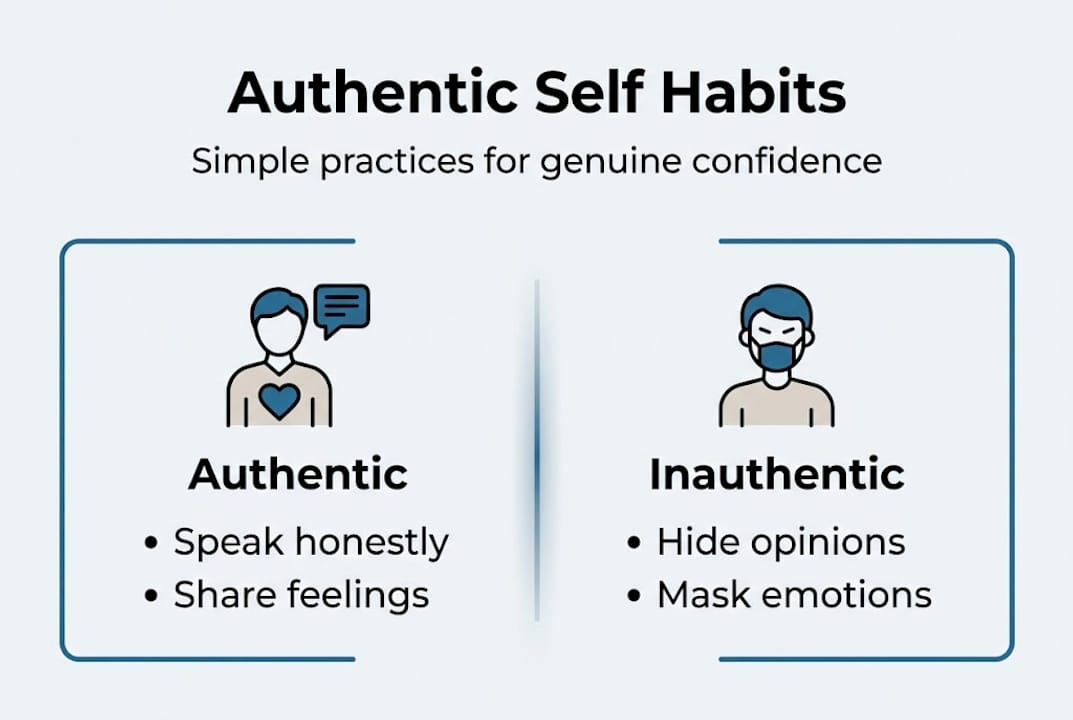
Here is a simple comparison to help visualize the shift:
Authentic habit | Inauthentic habit |
Expressing a genuine opinion, even if unpopular | Agreeing to avoid conflict |
Setting a boundary that protects your energy | Over-committing to gain approval |
Sitting with discomfort before responding | Reacting impulsively to manage perception |
Choosing relationships based on mutual respect | Staying in draining relationships out of obligation |
Making decisions aligned with your values | Making choices based on what others expect |
Building these habits works best when embedded in a structured self-care routine that protects your mental and emotional bandwidth. Without that foundation, even the best intentions get worn down by daily stress.
Pro Tip: Before making any significant decision, take a 60-second mindful pause. Ask yourself: “Does this align with what I actually value, or am I responding to external pressure?” That simple check builds an internal compass over time.
Our take: Authentic living is radical self-acceptance, not perfection
After covering the research and the practical methods, we want to offer a perspective that most authenticity content misses entirely. Authentic living is not about acting on every impulse or sharing every thought. It is not about performing a curated version of “your true self” on social media. Real authenticity is quieter and more demanding than that.
It requires radical self-acceptance, meaning you acknowledge your contradictions, your limitations, and your ongoing evolution without demanding that you have it all figured out. You do not need to be perfectly consistent to be genuine. You can hold competing values, change your mind, and still be an authentic person.
The most resilient people we encounter are not those who never wear a social mask. They are the ones who know when they are wearing one and why, and they choose realness deliberately when it serves their growth and their relationships. That conscious choice is what authenticity actually looks like in practice. Pairing this with intentional self-care for authenticity creates the sustainable foundation that makes genuine living not just possible, but lasting.
Explore more ways to enhance emotional well-being
Authenticity is an ongoing practice, and having the right support makes all the difference. If this article has sparked a desire to go deeper into your emotional wellness journey, there is a wealth of resources waiting for you.
At Life So Well, we are committed to helping you build the habits, mindset, and resilience that make authentic living possible every day. Whether you are just starting to tune into your values or looking to strengthen your emotional foundations, you can explore emotional well-being through guides, practical tips, and inspiration designed to meet you where you are. Your next step toward a more genuine, fulfilling life is closer than you think.
Frequently asked questions
Can being true to yourself ever conflict with social or cultural expectations?
Yes, social norms and roles can sometimes discourage authenticity, making it challenging to always express your true self. Research confirms that not all can afford full authenticity due to power dynamics and systemic pressures.
Does authenticity really improve mental health?
Research shows that authenticity is closely tied to higher self-esteem and better mental health outcomes. Empirical data links authenticity to reduced anxiety, stronger relationships, and greater life satisfaction.
What are simple ways to start being more authentic?
Start with daily self-reflection through journaling, practice mindfulness to build internal awareness, and identify your core values so your daily choices have a clear compass to follow.
Is it possible to be too authentic?
Absolute authenticity in every situation may sometimes harm relationships or careers, so balancing honesty with context sensitivity is wise. Research notes that surface acting and social roles affect well-being precisely because not all situations allow for full self-expression.
Recommended


Comments