
What is positive psychology? Science-backed paths to well-being

TL;DR:
Positive psychology studies strengths, joy, and resilience to promote human thriving.
The PERMA model identifies five pillars: positive emotions, engagement, relationships, meaning, and accomplishment.
While effective, positive psychology emphasizes self-compassion and contextual awareness to avoid potential pitfalls.
Most people assume psychology is about diagnosing what’s broken and fixing it. That’s understandable, but it’s only half the picture. Positive psychology flips the script entirely, asking not “what’s wrong?” but “what helps people thrive?” It’s a science-backed discipline that studies strengths, joy, meaning, and resilience, and it has quietly reshaped how researchers, coaches, and everyday people think about mental well-being. This article walks you through what positive psychology is, the frameworks behind it, the tools you can use today, and the honest limitations you should know before diving in.
Table of Contents
Key Takeaways
Point | Details |
Strengths-based focus | Positive psychology centers on building strengths and well-being instead of just treating problems. |
Evidence-based interventions | Practical tools like gratitude journaling and mindfulness are validated by scientific research. |
Limitations exist | It is not a substitute for therapy and can be misapplied as toxic positivity if used without care. |
Personalized practice | Choose interventions that match your needs and context for the best results. |
Small steps matter | Sustainable well-being comes from consistent, gentle practice rather than chasing constant happiness. |
What is positive psychology? Core concepts explained
Positive psychology is more than a motivational buzzword. It’s a legitimate scientific field. As defined by researchers, positive psychology focuses on strengths, positive human experiences, and factors enabling individuals and communities to thrive, rather than solely on mental illness and pathology. That distinction matters more than it might seem.
Traditional psychology spent most of the 20th century focused on what goes wrong in the human mind. Anxiety, depression, trauma, and personality disorders were the central concerns. That work is essential, but it left a gap: almost no scientific attention was paid to what makes life worth living when things are going well.
That changed in 1998. Martin Seligman, then president of the American Psychological Association, used his inaugural address to call for a new direction. He argued that psychology needed to study human flourishing with the same rigor it applied to dysfunction. That speech launched positive psychology as a formal field.
“The goal is not to replace the study of suffering, but to build a science of what makes life most worth living.” This framing is what separates positive psychology from self-help culture. It’s empirical, not aspirational.
Here’s what positive psychology actually aims to do:
Amplify personal strengths rather than only patching weaknesses
Cultivate optimism and resilience through evidence-based practices
Foster positive relationships and a sense of community belonging
Promote meaning and purpose as measurable components of well-being
Support community-level thriving, not just individual happiness
This is why building a positive mental attitude isn’t just feel-good advice. It’s grounded in decades of research showing that how you orient your thinking shapes measurable outcomes in health, relationships, and performance.
Key frameworks: The PERMA model and science behind well-being
Now that we’ve set the stage with what positive psychology is, let’s see how academics and practitioners structure “the good life” scientifically.
The most widely used framework is the PERMA model, developed by Seligman. It identifies five pillars that together describe a flourishing life: Positive Emotions, Engagement, Relationships, Meaning, and Accomplishment. Each pillar is measurable and actionable, which is what makes this model so useful in practice.
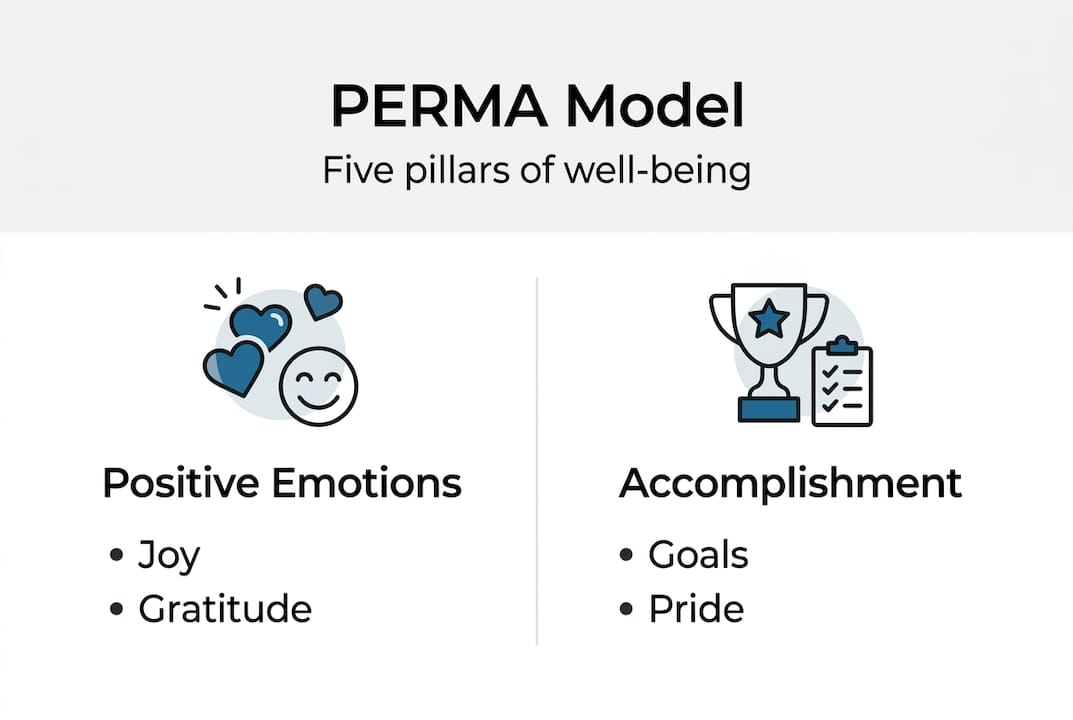
PERMA pillar | What it means | Example activity |
Positive Emotions | Experiencing joy, gratitude, hope | Keeping a daily gratitude journal |
Engagement | Deep focus and flow in activities | Losing yourself in a creative project |
Relationships | Genuine connection with others | Scheduling a weekly check-in with a friend |
Meaning | Feeling part of something larger | Volunteering for a cause you care about |
Accomplishment | Pursuing and achieving goals | Completing a personal challenge or skill |
Here’s how you might recognize each pillar showing up in your daily life:
Positive Emotions: You notice a moment of genuine laughter or feel calm after a walk outside.
Engagement: You sit down to work on something and look up to find two hours have passed.
Relationships: A conversation with someone leaves you feeling energized rather than drained.
Meaning: You feel a quiet sense of purpose after helping a colleague or stranger.
Accomplishment: You finish a task you’ve been avoiding and feel a real sense of satisfaction.
None of these require dramatic life changes. They’re already present in your days, often unnoticed.

Pro Tip: Instead of trying to address all five PERMA pillars at once, combine two that naturally overlap for you. Pairing Relationships with Meaning, for example by volunteering alongside a friend, creates a ripple effect that strengthens both pillars simultaneously and makes the habit far easier to sustain.
If you want to reinforce the Positive Emotions pillar specifically, a structured positive affirmation guide can help you build that practice with intention rather than guesswork.
How positive psychology works: Interventions and daily practices
The backbone of positive psychology is its evidence-based “interventions.” Here’s how they look in practice and why they’re effective.
Positive Psychology Interventions, or PPIs, are structured activities designed to increase well-being by targeting one or more PERMA pillars. Research confirms that PPIs include gratitude journaling, strengths identification using the VIA survey, mindfulness, savoring positive experiences, acts of kindness, and goal setting. Each has been studied in controlled settings with real populations.
The numbers back them up. Meta-analyses show PPIs yield small-to-moderate effects on well-being, with a standardized mean difference of 0.34 for subjective well-being, 0.20 for psychological well-being, and 0.23 for depression reduction. Effects are sustained for three to six months and work across diverse populations.
PPI type | Primary benefit | Time to notice effect | Duration of benefit |
Gratitude journaling | Mood and optimism | 1 to 2 weeks | 3 to 6 months |
Strengths identification | Confidence and engagement | 1 to 3 weeks | Ongoing with use |
Mindfulness practice | Stress reduction, focus | 2 to 4 weeks | Sustained with practice |
Acts of kindness | Connection and mood | Immediate | Short to medium term |
Goal setting | Motivation and accomplishment | 2 to 4 weeks | Tied to goal timeline |
Here are some accessible PPIs you can start today:
Write down three specific things you’re grateful for each evening, not generic ones
Take the free VIA Character Strengths survey online and use your top strength intentionally this week
Practice a five-minute body scan or breathing exercise before bed
Do one small act of kindness for someone without announcing it
The benefits of mindfulness extend well beyond relaxation, touching attention, emotional regulation, and even physical health markers. Similarly, structured stress management tips can work hand-in-hand with PPIs to create a more complete approach to daily well-being.
Pro Tip: Track your progress lightly. A simple one-line daily note about which practice you did is enough. Over-tracking creates pressure that can turn a joyful habit into a chore, which defeats the purpose entirely.
Critiques and cautions: The limits of positive psychology
Understanding the evidence also means addressing its limits and learning when to exercise caution.
Positive psychology has real critics, and their concerns deserve honest attention. Documented criticisms include lack of theorizing, methodological flaws, pseudoscience claims, cultural bias, neoliberal individualism that ignores systemic context, toxic positivity, and the commercialization of happiness. These aren’t fringe objections. They come from within academic psychology itself.
Here’s where positive psychology can backfire or fall short:
Forced optimism: Telling someone in genuine crisis to “focus on the good” can minimize real suffering and erode trust
Cultural mismatch: Many PPIs were developed in Western, individualistic contexts and don’t translate equally across cultures
Ignoring systemic hardship: Poverty, discrimination, and chronic illness require structural solutions, not just mindset shifts
Replacing professional care: Using positive psychology tools instead of therapy for serious mental health conditions can delay necessary treatment
Perfectionism trap: Striving to be relentlessly positive can itself become a source of shame and anxiety
Toxic positivity, the pressure to maintain a positive outlook regardless of circumstances, is one of the most common misapplications of positive psychology. Genuine well-being includes the ability to sit with difficult emotions, not suppress them.
Understanding what toxic positivity looks like in real life can help you apply positive psychology more skillfully and compassionately.
Expert guidance is clear that positive psychology complements but does not replace traditional therapeutic approaches. If you’re managing depression, trauma, or any diagnosed condition, work with a qualified mental health professional. PPIs can be a valuable addition to that care, not a substitute for it.
How to use positive psychology for personal growth
With benefits and limits in mind, here’s how you can realistically apply positive psychology principles to your life.
The smartest starting point is self-assessment. Before picking a practice, understand where you currently stand. The PERMA profiler is a free, validated questionnaire that scores each pillar of your well-being. The VIA Character Strengths survey identifies your top personal strengths from a list of 24. Both are available online at no cost and take under 20 minutes.
Once you have a baseline, follow these steps:
Identify your lowest PERMA pillar. This is your highest-leverage starting point, not your weakest area to criticize.
Choose one or two PPIs that align with that pillar and fit your lifestyle. A busy parent might start with a two-minute gratitude note. A remote worker might prioritize a weekly social connection.
Start smaller than you think necessary. Micro-practices, like savoring your morning coffee for 60 seconds or noticing one thing you did well today, build the neural pathways that support bigger changes later.
Review lightly every two weeks. Ask yourself: does this feel sustainable? Is anything shifting? Adjust without judgment.
Add a second practice only when the first feels effortless. Stacking habits too fast is the most common reason people abandon them.
Know when to seek support. If your well-being scores are consistently low or you’re experiencing persistent sadness, anxiety, or hopelessness, reach out to a mental health professional.
Spending time in nature is one of the most underrated micro-practices available to you. The health benefits of nature on mental health are well-documented and pair naturally with mindfulness and savoring. You can also strengthen your cognitive engagement pillar through targeted mental exercises that sharpen focus and support a sense of accomplishment.
A fresh perspective: What most guides miss about positive psychology
After learning the frameworks and adopting practical steps, it’s worth reconsidering what really drives change for most people.
Here’s what we’ve noticed: the people who benefit most from positive psychology aren’t the ones who try hardest. They’re the ones who stop fighting themselves. Positive psychology works best not as a performance of happiness, but as a gentle reorientation toward what already matters to you.
Most guides focus on adding practices. Fewer talk about the environment you’re practicing in. If your daily context is chronically stressful, isolating, or unsupportive, no amount of gratitude journaling will fully compensate. Context shapes behavior far more than willpower does.
Self-compassion is the quiet engine behind sustainable growth. When you miss a day, skip a practice, or feel worse despite trying, the research-backed response isn’t to push harder. It’s to treat yourself with the same kindness you’d offer a friend. That single shift, from self-criticism to self-compassion, often produces more lasting change than any specific intervention. Explore more ideas like this in our mind guides for ongoing support.
Start your journey with Life So Well
If you’re ready to take your next step, here are resources that support your path.
Positive psychology gives you a map, but navigating it well takes ongoing support and the right resources. At Life So Well, we’ve built a library of practical, research-informed guides designed to help you apply these principles in real, everyday ways.
Whether you’re working on emotional awareness, building better habits, or simply trying to understand yourself more clearly, our explore your emotions section is a great place to continue. You’ll find tools and perspectives that complement everything covered in this article, grounded in the same science-backed approach that makes positive psychology so powerful when applied thoughtfully.
Frequently asked questions
What is the main goal of positive psychology?
Its main goal is to scientifically study and promote human flourishing by focusing on strengths and positive experiences rather than just treating mental illness.
Are positive psychology interventions really effective?
Meta-analyses confirm that interventions like gratitude journaling and strengths work yield small-to-moderate improvements in well-being, with effects sustained for three to six months across diverse populations.
Is positive psychology the same as just “thinking positive”?
No. It’s a research-based approach with proven interventions that also recognizes systemic context and critiques forced optimism as a potential harm rather than a goal.
Can positive psychology replace therapy or medication?
Expert consensus is clear that it complements but does not replace professional mental health treatment, and is best suited for personal growth and well-being enhancement.
What is the PERMA model in positive psychology?
The PERMA model is a framework outlining five measurable pillars of well-being: Positive Emotions, Engagement, Relationships, Meaning, and Accomplishment.
Recommended


Comments