
Fast fashion's impact on your mind, ethics, and planet
TL;DR:
Fast fashion accounts for 8 to 10% of global carbon emissions, surpassing flights and shipping combined.
It relies on rapid production, synthetic fibers, and low-wage labor, causing significant environmental and ethical harm.
Consumers can support change through mindful purchasing, choosing transparent brands, and advocating for policy improvements.
Fast fashion generates 8 to 10% of global carbon emissions, more than international flights and maritime shipping combined. That single fact reframes what feels like a personal shopping habit into a planetary-scale problem. But the ripple effects go further than carbon. Your mental well-being, your sense of ethics, and your daily stress levels are all quietly shaped by how the fashion industry operates. This guide breaks down the mechanisms driving fast fashion’s outsized footprint, traces its hidden costs to workers and ecosystems, and gives you practical, evidence-backed tools to make choices that feel as good as they look.
Table of Contents
Key Takeaways
Point | Details |
Fast fashion’s massive impact | It is responsible for more carbon emissions than all international flights and shipping combined. |
Ethics matter | Most industry workers earn below a living wage in unsafe environments. |
Mindful shopping helps well-being | Choosing slow, sustainable fashion can improve your mental health and reduce your carbon footprint. |
True change is systemic | Look for brands with transparent supply chains and join broader efforts beyond individual shopping. |
How fast fashion works: speed, volume, and the supply chain
Fast fashion is not simply cheap clothing. It is a business model built on speed, volume, and planned obsolescence, meaning garments are designed to be replaced quickly rather than worn for years. Where traditional fashion offered two seasonal collections per year, major fast fashion retailers now release new styles weekly or even daily. That pace is only possible because of a tightly engineered global supply chain.
The rapid supply chain mechanics that power this industry rely on synthetic fibers, global outsourcing to low-wage countries, and social media-driven overconsumption. Influencer culture accelerates the cycle further, turning trend awareness into instant purchasing pressure. The result is a system that produces far more clothing than the world can meaningfully use.
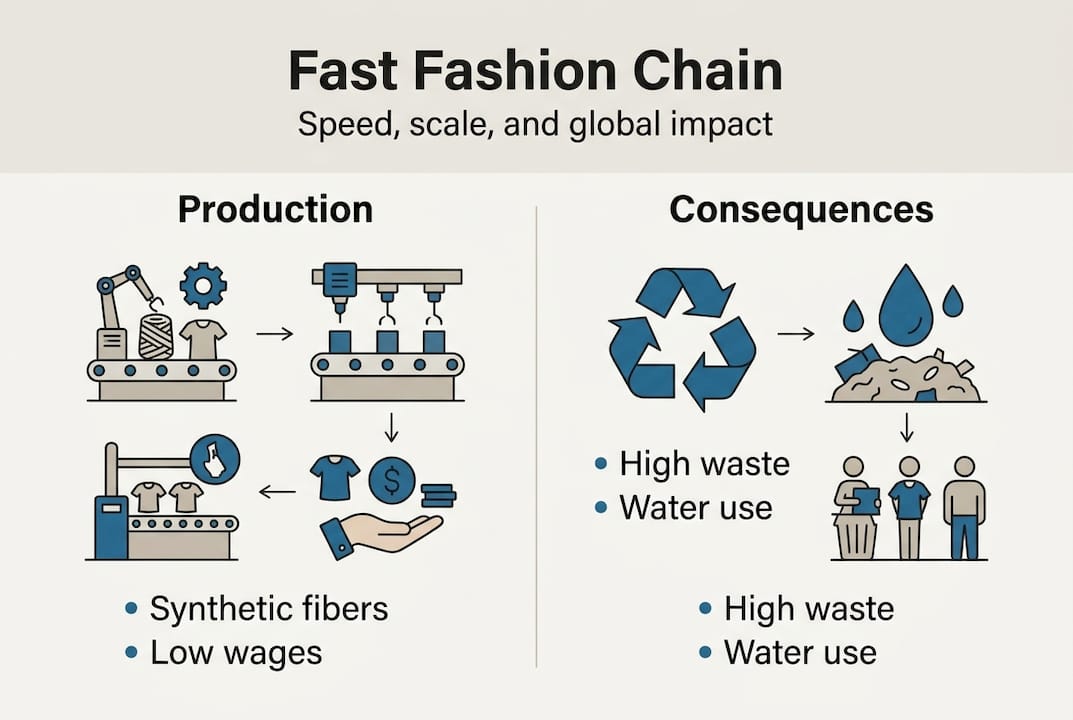
Here is a snapshot of what that looks like at scale:
Metric | Fast fashion reality |
New styles released (Shein) | Up to 10,000 items per day |
Average garment wears before disposal | 7 to 10 times |
Synthetic fiber share of production | Over 60% |
Clothing items produced globally per year | Over 100 billion |
The hidden costs of fast fashion are embedded in every step of this chain, from raw material extraction to the landfill. Understanding these mechanics helps you see why surface-level fixes rarely solve the deeper problem.
Key drivers that keep this cycle spinning:
Synthetic dominance: Polyester and nylon are cheap but shed microplastics with every wash, entering waterways and food chains.
Design-to-retail speed: Some brands move a design from concept to shelf in as little as two weeks.
Planned obsolescence: Thin fabrics and trend-driven cuts ensure items feel dated or fall apart within months.
Influencer amplification: Social platforms reward novelty, creating constant pressure to buy the next new thing.
Pro Tip: When evaluating a brand, look for published supplier lists, third-party audits, and collection cycles of four or fewer per year. These are early signals of a slower, more accountable model.
Fast fashion’s true cost: environmental and ethical damage
With an understanding of fast fashion’s engine, it is time to see how that engine translates into real-world costs for people and the planet.
The environmental numbers are staggering. The industry consumes 93 billion cubic meters of water annually and generates 92 million tons of textile waste each year. To put that in perspective, one pair of jeans requires roughly 1,800 gallons of water to produce, from cotton farming to finishing.
Impact area | Annual scale |
Water consumption | 93 billion cubic meters |
Textile waste generated | 92 million tons |
Share of ocean microplastic pollution | 35% from synthetic textiles |
Carbon emissions share | 8 to 10% of global total |
The social costs are just as severe. 93% of fast fashion brands do not pay living wages, and approximately 75 million garment workers, the majority of them women, earn poverty-level pay while facing dangerous working conditions. The 2013 Rana Plaza factory collapse in Bangladesh, which killed over 1,100 workers, remains the most visible symbol of what those conditions can mean in practice.
The environmental impacts of fashion extend into communities near dyeing and finishing factories, where untreated wastewater contaminates rivers used for drinking and farming. These are not abstract harms. They are daily realities for millions of people.
“The true price of a five-dollar T-shirt is paid by the worker who made it and the river that absorbed its dyes.”
Why do individual actions still matter within a systemic problem? Because purchasing decisions collectively signal demand. When enough people shift their spending, it creates financial pressure on brands to change sourcing, materials, and wage policies. Your choices are one thread in a much larger fabric.
Mental health and mindful consumption: the hidden connection
Environmental and social harms are only half the story. Let us dig into what fast fashion means for your mind and daily life.
Fast fashion marketing is engineered to create dissatisfaction. Flash sales, limited-time drops, and influencer hauls trigger a dopamine loop where buying feels exciting but satisfaction fades quickly. Research consistently links compulsive buying to lower self-esteem, increased anxiety, and a persistent sense that what you own is never quite enough. The shift to sustainable fashion reduces your carbon footprint, avoids ethical complicity, and actively boosts mental well-being through more intentional, mindful choices.
Slow fashion, by contrast, encourages you to invest in fewer, better pieces. That shift changes your relationship with your wardrobe from a source of stress to a source of confidence. When every item you own fits well, aligns with your values, and lasts for years, getting dressed becomes simple rather than overwhelming.
Practical steps toward mindful consumption:
Audit your wardrobe. Pull out everything you own and identify what you actually wear. Donate or repair the rest.
Set a buying pause. Wait 30 days before purchasing any non-essential clothing item. Most impulse urges fade.
Research before you buy. Spend five minutes checking a brand’s supply chain transparency before checkout.
Choose quality over quantity. One well-made garment worn 100 times beats ten cheap ones worn five times each.
Connect clothing to values. Ask yourself whether a purchase aligns with the kind of life you want to build.
This mindful approach mirrors what enhancing mental health through intentional living looks like in practice. Reducing decision fatigue, aligning spending with values, and breaking compulsive loops all support emotional resilience.
Pro Tip: Build a capsule wardrobe of 30 to 40 versatile, high-quality pieces. Studies show that fewer choices reduce daily stress and increase long-term satisfaction with your appearance.
Beyond greenwashing: what real ethical fashion looks like
Knowing the pitfalls, it is crucial to empower yourself to find and support truly ethical alternatives.
Many brands have responded to growing consumer awareness by launching “eco” collections, using recycled packaging, or pledging carbon neutrality. But lifecycle assessment (LCA) research, which measures environmental impact from raw material to disposal, shows that the raw material stage dominates impacts, and recycling offers limited offsets when overall production volumes keep rising. Greenwashing, meaning the practice of making misleading environmental claims, exploits your good intentions without delivering real change.
The numbers confirm the gap. Only 0.3% fashion circularity has been achieved industry-wide, and most brand pledges do not cut net emissions or include living wage commitments. A recycling bin in a store does not undo the damage caused by producing ten times more garments than are needed.
Hallmark | Ethical brand | Greenwashing brand |
Supply chain | Full supplier list published | Vague “responsibly sourced” claims |
Wages | Living wage verified by third party | No wage data available |
Production volume | Slow, limited collections | High volume with “eco” line |
Circularity | Repair programs, take-back schemes | Recycling bin, no volume reduction |
Certifications | GOTS, Fair Trade, B Corp verified | Self-certified or unverified labels |
What to look for in a genuinely ethical solutions oriented brand:
Published, audited supplier lists updated annually
Third-party living wage verification, not just a pledge
Repair and resale programs that extend garment life
Transparent emissions data across the full supply chain
You can also browse the environmental category for deeper guidance on evaluating brand claims and building a more sustainable lifestyle.
Pro Tip: Support repair cafes, clothing swaps, and resale platforms in your community. These systemic behaviors reduce demand for new production far more effectively than choosing a “greener” brand within the same fast fashion volume.
What most fast fashion guides miss: the need for community-driven change
Most articles on ethical fashion stop at the individual level: buy less, buy better, choose certified brands. That advice is genuinely useful. But it places the entire burden of a systemic problem on individual consumers, which is both unfair and insufficient.
Real, lasting change requires worker voice, policy pressure, and community action. A just transition for workers is largely absent from most brand sustainability plans, even progressive ones. Garment workers, who understand the supply chain most intimately, are rarely included in designing solutions. That gap undermines the credibility of every “ethical” label.
Advocacy wins like the Bangladesh Accord on Fire and Building Safety, which was driven by unions and NGOs, show what collective pressure can achieve. Policy proposals such as extended producer responsibility laws, which require brands to fund end-of-life garment management, are gaining traction in the EU and parts of the US. Supporting these efforts, whether through signing petitions, contacting representatives, or backing worker-led organizations, amplifies your individual choices into something larger.
If you want to go further, exploring zero waste steps for daily life offers practical ways to extend this mindset beyond your wardrobe into every area of consumption.
Take action: align your values with your wardrobe
You have just mapped the full picture, from the carbon math to the human cost to the mental well-being connection. The next step is applying that clarity to your own life, and you do not have to figure it out alone.
Life So Well offers resources across emotional wellness and the environment category to help you build habits that align with your values. Whether you are working on mindful consumption, reducing stress around purchasing decisions, or understanding the broader environmental picture, you will find practical, evidence-backed guidance here. Small, consistent steps create real change, and this community is here to support every one of them.
Frequently asked questions
What is fast fashion and why is it considered unsustainable?
Fast fashion is the rapid production of cheap clothes to match current trends, but it is unsustainable because it drives 8 to 10% of global carbon emissions, consumes billions of cubic meters of water, and generates tens of millions of tons of textile waste every year.
How does fast fashion affect workers in the industry?
93% of fast fashion brands do not pay living wages, leaving approximately 75 million workers, mostly women, earning poverty-level pay while facing unsafe working conditions.
Can buying secondhand clothes really help the environment?
Secondhand shopping reduces demand for new production, but high buy frequency and short garment retention can reproduce fast fashion consumption patterns, so quality and longevity still matter even in resale markets.
What should I look for in an ethical fashion brand?
Prioritize brands with transparent supply chains and verified living wage policies, and look for third-party certifications like Fair Trade or GOTS rather than self-made marketing claims.
Recommended


Comments