
Flirting guide: Boost your confidence and connection skills

TL;DR:
Flirting is a clear form of emotional communication signaling intimacy and interest.
Effective flirting involves genuine curiosity, humor, subtle touch, and responsive listening.
Authentic presence and self-awareness are key to building meaningful social connections.
Flirting can feel like navigating a maze blindfolded. You notice someone interesting, your heart rate picks up, and suddenly every word feels clumsy and every glance feels ambiguous. Sound familiar? The good news is that flirting is not as mysterious as it seems. Research shows clear, identifiable patterns in how people signal interest and build connection. This guide walks you through the science and practical steps behind effective flirting, so you can approach social interactions with genuine confidence, read signals more accurately, and build the kind of connections that actually mean something.
Table of Contents
Key Takeaways
Point | Details |
Flirting is not always ambiguous | Verbal and nonverbal cues often clearly signal intention during flirting. |
Effective techniques boost connection | Humor, vulnerability, and positive signals like touch strengthen social bonds. |
Preparation increases flirting success | Self-reflection and confidence-building activities set the stage for genuine connection. |
Adapt in the moment | Reading feedback and respecting boundaries are crucial in all flirting interactions. |
Authenticity is key | Genuine presence and adaptability create the strongest and most rewarding connections. |
Understanding flirting: Purpose and misconceptions
Before you can flirt well, you need to understand what flirting actually is. Most people assume it is inherently ambiguous, a vague dance of mixed signals and guesswork. But research tells a different story. Flirting is often not ambiguous in real interaction; it is identifiable through what researchers call epistemic claims to intimacy, meaning the way people use language and behavior to signal closeness or special knowledge of another person.
There are two major ways experts frame flirting. Evolutionary psychology views flirting as a mate competition tactic, while discourse analysis sees it as interactionally oriented and not always tied to romantic pursuit. Both perspectives have merit, but the practical takeaway is this: flirting serves different purposes in different contexts, and understanding that range helps you engage more authentically.
Here is a quick comparison of how these two frameworks see flirting:
Framework | Core belief | Flirting goal |
Evolutionary psychology | Flirting signals genetic fitness | Attract a romantic partner |
Discourse analysis | Flirting is a social tool | Build intimacy and rapport |
Some common misconceptions get in the way of effective flirting:
Flirting always means romantic interest. Not true. Playful banter can simply strengthen a social bond.
Ambiguity is unavoidable. Research shows clear cues exist if you know what to look for.
Flirting requires confidence you do not have. Confidence is a skill, not a personality trait.
Flirting is manipulative. When done with respect, it is a natural form of human connection.
“Flirting is not inherently ambiguous. In real interactions, people use specific communicative moves to signal intimacy and interest.” (Flirting as Interaction, 2017)
Understanding emotion in relationships is a powerful foundation here. When you recognize that flirting is a form of emotional communication, not a performance, the pressure starts to lift.
Preparing to flirt: Confidence, mindset, and environment
With a clearer sense of what flirting is and is not, let us prepare ourselves mentally and physically. The biggest barrier most people face is not a lack of clever lines. It is a lack of readiness. Confidence is not something you either have or do not have. It is something you can build, moment by moment.
Start with a self-assessment. Ask yourself: What am I hoping to get from this interaction? Am I looking for a genuine connection, a fun exchange, or something more? Setting clear intentions removes a lot of the anxiety that comes from uncertainty. When you know what you want, you act with more ease.
Environment matters more than people realize. A relaxed, social setting like a coffee shop or a casual event creates natural opportunities for conversation. Loud, crowded bars can work, but they often raise the stakes unnecessarily. Choose environments where you feel comfortable and where conversation flows naturally.
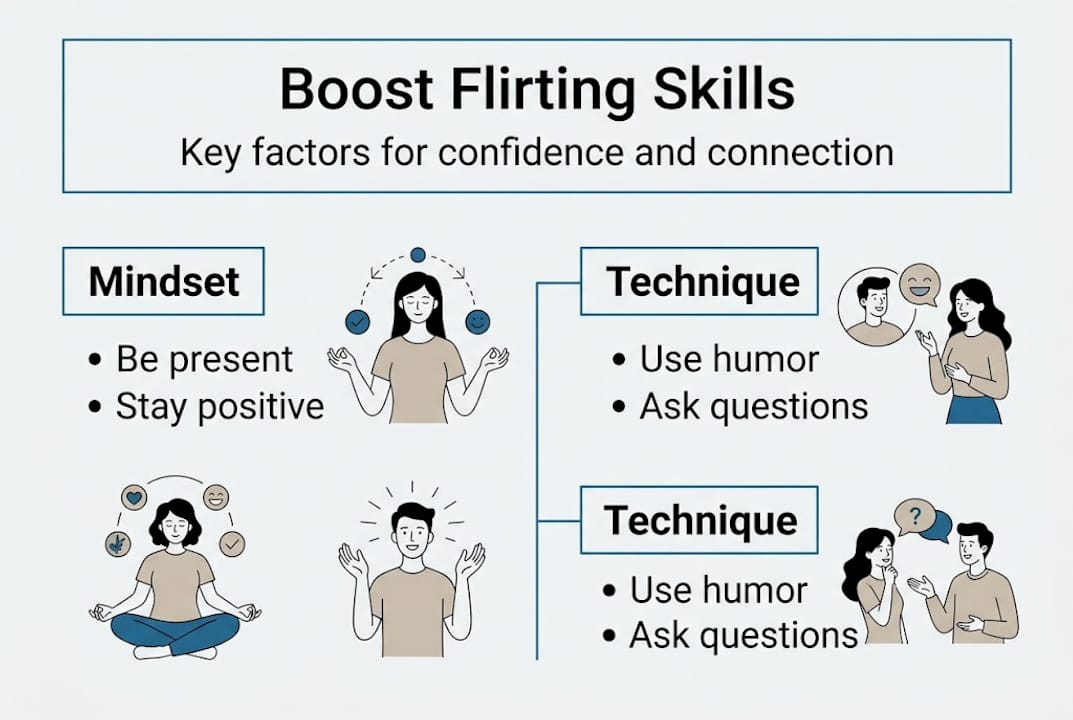
Research confirms that effective flirting tactics include showing vulnerability, offering help, using humor, and using tie-signs like touch and laughter. These are not grand gestures. They are small, human moments that signal warmth and openness.
Here is a quick-start confidence checklist before approaching someone:
Take three slow, deep breaths to calm your nervous system.
Remind yourself of a recent moment you felt genuinely at ease socially.
Set a simple intention, like “I just want to have a real conversation.”
Adjust your posture: shoulders back, open body language.
Smile before you approach, not as a performance but as a genuine warmup.
Confidence factor | Low readiness sign | High readiness sign |
Mindset | Focused on outcome | Focused on connection |
Body language | Closed, tense | Open, relaxed |
Intention | Vague or pressured | Clear and low-stakes |
Pro Tip: Cultivating a positive mental attitude before social situations is not just motivational fluff. It genuinely shifts how others perceive you. And taking care of yourself through self-care practices builds the kind of inner stability that makes confidence feel natural rather than forced.
Flirting in action: Step-by-step techniques
After preparing your mindset and environment, here is how to put flirting techniques into practice. Think of this as a rhythm, not a script. The goal is to stay present and responsive, not to execute a performance.
Step 1: Start with a warm, genuine opener. Skip the rehearsed lines. A simple, situationally relevant comment works far better. Comment on something in your shared environment, ask a light question, or offer a genuine compliment that is specific rather than generic. “I love that you ordered the same thing I always do” beats “You have a great smile” every time.
Step 2: Use humor early and often. Laughter is a tie-sign, a signal of shared understanding and ease. Humor and touch are among the most effective flirting tools in competitive social contexts. Light teasing, playful observations, and self-deprecating humor all signal confidence without arrogance.
Step 3: Show genuine curiosity. Ask follow-up questions. Remember small details. This signals that you are actually listening, which is surprisingly rare and deeply attractive.
Step 4: Use appropriate touch as a tie-sign. A brief touch on the arm during laughter, or leaning slightly closer during conversation, signals warmth and interest. Always read the response before continuing.
Key signals that the interaction is going well:
They mirror your body language.
They laugh at your jokes and offer their own.
They ask you questions back.
Their body is oriented toward you.
They extend the conversation when you pause.
Pro Tip: Strengthening your relationships through genuine curiosity and active listening is one of the most underrated flirting tools. People remember how you made them feel, not what you said.
Building emotional stability also helps you stay grounded when the conversation takes an unexpected turn, which it often will.

Troubleshooting: Navigating challenges and missteps
Even with the best preparation and techniques, flirting can be challenging. Here is what to do if things do not go as planned.
First, recognize when to shift gears. Not every interaction will spark. That is not failure. That is data. If someone gives short answers, avoids eye contact, or physically turns away, those are clear signals to gracefully exit the conversation. You do not need to analyze it or apologize excessively.
Communication cues often signal intent clearly, even when words stay polite. A closed-off posture, clipped responses, or a sudden interest in their phone are all signs that the energy is not mutual. Respecting those signals is not just considerate. It is also the most attractive thing you can do.
Here is how to handle common flirting missteps:
You said something awkward. Laugh it off lightly and move on. Over-apologizing makes it worse.
They did not laugh at your joke. Acknowledge it with a smile and redirect. “Okay, that one did not land. Let me try again.”
You misread a signal. Simply recalibrate. Step back slightly, ask a neutral question, and let them set the new pace.
You feel nervous mid-conversation. Take a breath and slow down. Nervousness often reads as enthusiasm when you stay warm.
The conversation dies. Use a pivot question tied to the environment or a topic they mentioned earlier.
“Flirting is not a fixed script. It is a dynamic exchange that requires reading and responding to the other person’s cues in real time.”
Practicing mindfulness for social skills can dramatically improve your ability to stay present and read these cues without overthinking them. Mindfulness trains you to notice without judgment, which is exactly what good flirting requires.
Measuring success and growing your connections
Once you have started to apply flirting techniques, it is important to observe your results and build on your progress. Success in flirting is not just about whether someone gives you their number. It is about whether you felt genuine, present, and connected during the interaction.
Flirting can enhance intimacy and emotional connection in meaningful ways, even in brief encounters. That ripple effect matters. A warm, playful conversation can lift your mood, boost your social confidence, and open doors to deeper relationships over time.
Here is how to track your progress authentically:
After each interaction, ask yourself: Did I feel present? Did I listen well? Did I stay true to myself?
Notice patterns: Which openers felt natural? Which moments created genuine laughter or connection?
Celebrate small wins: A great conversation, even without a follow-up, is a real success.
Keep a brief social journal: Jot down one thing that worked and one thing you would adjust next time.
Statistic to know: Studies on social connection consistently show that people who engage in warm, playful interactions report higher levels of emotional well-being and life satisfaction.
Spending time in restorative environments also supports the emotional resilience you need to keep putting yourself out there. And returning to a positive mental attitude after setbacks is what separates people who grow socially from those who stay stuck.
Why authentic flirting works and what most guides miss
Most flirting guides hand you a list of clever lines and call it a day. That approach misses the point almost entirely. The truth is, memorized techniques tend to backfire because people are remarkably good at detecting inauthenticity. When you are running a script, your attention is on the script, not on the person in front of you.
What actually works is presence. Real flirting is about being genuinely curious, responding to what is actually happening in the moment, and letting the other person feel seen. That is it. No trick required.
The benefits of mindfulness translate directly here. When you practice being present, you become a better listener, a more natural communicator, and someone people genuinely enjoy being around. That is the foundation of every meaningful connection.
The uncomfortable truth is that most people do not need better lines. They need to stop performing and start connecting. Authenticity is not a soft concept. It is the most powerful social tool you have.
Build your confidence with more social wellness tools
Building genuine connections takes practice, self-awareness, and the right support along the way. You do not have to figure it all out alone.

At Life So Well, you will find a growing library of resources designed to support your personal growth, from mindfulness practices to emotional resilience strategies. Whether you are working on your confidence, your communication style, or simply looking to strengthen your social connections, there is something here for every stage of your journey. Explore the platform and take the next step toward a more connected, fulfilling social life.
Frequently asked questions
What is the main goal of flirting?
The main goal of flirting is to signal romantic or playful interest and build intimacy. Research confirms that flirting signals intimacy through specific communicative moves, not just vague signals.
What are the most effective flirting techniques?
The most effective techniques include showing vulnerability, using humor, offering help, and using tie-signs like touch and laughter. These tactics are consistently rated as the most impactful across social contexts.
Is flirting always about romantic intent?
No. Flirting can be playful and social without any romantic goal. Discourse analysis frames flirting as interactionally oriented, meaning it can simply strengthen a bond or lighten a social moment.
How can I tell if someone is flirting with me?
Look for humor, playful teasing, mirrored body language, and more personal or direct conversation. Epistemic claims to intimacy like teasing and innuendo are reliable indicators of flirtatious intent.
How do I recover from a flirting mistake?
Stay calm, acknowledge the moment lightly, and use humor or a brief apology to reset the tone. Most awkward moments pass quickly when you respond with warmth rather than panic.
Recommended


Comments