
How to love yourself: practical steps for self-care
- teamlifesowell
- 15 hours ago
- 8 min read

TL;DR:
Self-love combines self-care and self-acceptance to improve relationships and emotional resilience.
Consistent daily practices like mindfulness and loving-kindness meditation foster genuine self-compassion.
Progress relies on regular effort over time, not quick fixes or intense short-term efforts.
Self-criticism has a way of creeping in quietly, turning small mistakes into sweeping judgments about your worth. If you’ve ever caught yourself thinking “I’m not good enough” after a tough day, you’re not alone. Self-love isn’t a personality trait you either have or don’t. It’s a skill, and science backs that up. This guide walks you through the real foundations of self-love, the practical tools to build it, and the measurable ways it transforms your relationships, your resilience, and your daily life. No fluff, no quick fixes. Just honest, evidence-based steps you can start today.
Table of Contents
Key Takeaways
Point | Details |
Self-love boosts resilience | Cultivating self-love directly enhances emotional strength and coping skills. |
Relationships benefit | Self-care and self-acceptance lead to greater intimacy and commitment with others. |
Consistency is essential | Daily practice of self-love is scientifically proven to accelerate results. |
Authenticity grows | Self-compassion helps you express your true self, independent of self-esteem. |
Understand the foundation of self-love
Before you can practice self-love, you need to know what it actually is. Self-love isn’t about feeling happy all the time or ignoring your flaws. It’s a combination of self-care (the actions you take to protect your physical and emotional health) and self-acceptance (the willingness to see yourself clearly without harsh judgment). These two components work together, and neither one is complete without the other.
Research confirms that self-love components like self-care and self-acceptance directly predict passion, intimacy, and commitment in romantic relationships. That’s a striking finding. How you treat yourself ripples outward into every relationship you have. When you accept your own imperfections, you tend to extend that same grace to others. When you invest in self-care for mental health, you show up with more energy and emotional availability for the people you love.
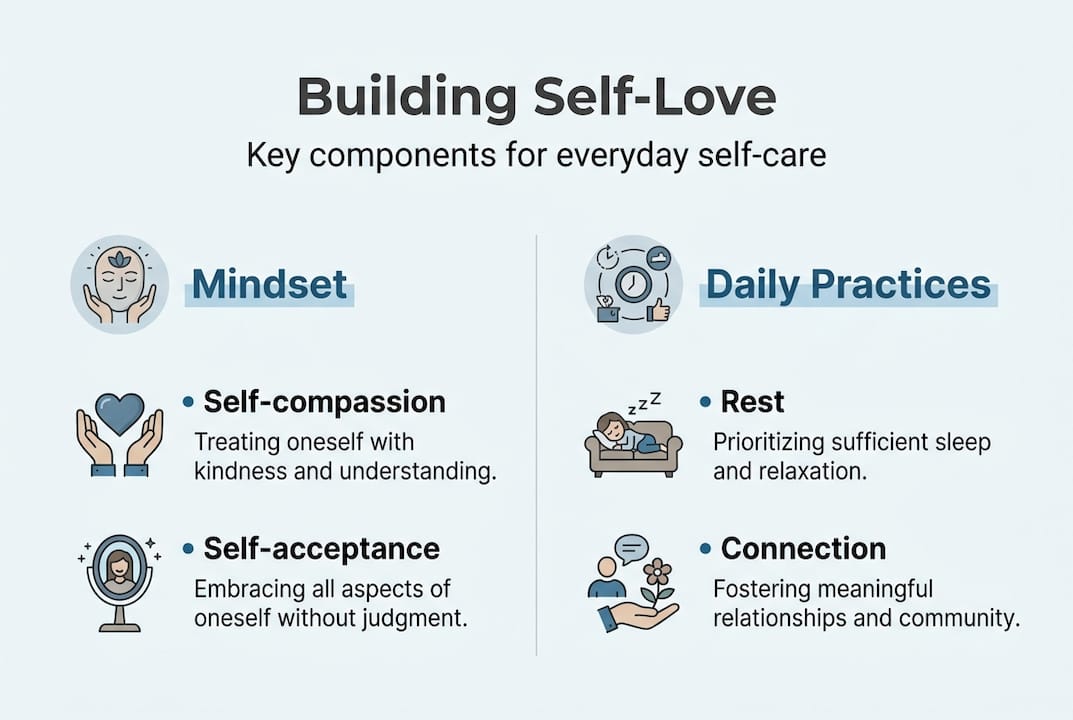
Here’s a quick overview of the core components and what they influence:
Self-love component | What it means | Key benefit |
Self-care | Nurturing your body and mind | Reduces stress, builds energy |
Self-acceptance | Embracing yourself without judgment | Improves emotional stability |
Self-compassion | Responding to failure with kindness | Strengthens resilience |
Self-awareness | Understanding your needs and limits | Supports healthy boundaries |
Each of these works like a gear in a larger system. When one is missing, the others don’t function as well. For example, you can practice self-care rituals every morning, but if you still speak harshly to yourself when you make a mistake, the benefits are limited.
Self-love also shapes how you navigate your relationships in broader ways. People who genuinely love themselves tend to set clearer boundaries, communicate more honestly, and recover faster from conflict. They’re less likely to seek external validation as a substitute for internal security. That’s not a coincidence. It’s a direct result of building a stable, compassionate relationship with yourself first.
Self-care includes sleep, nutrition, movement, and emotional boundaries
Self-acceptance means holding your strengths and weaknesses without shame
Self-compassion involves treating yourself the way you’d treat a close friend
Self-awareness helps you recognize when you’re running on empty
Think of self-love as the root system of a tree. Everything visible above ground, your confidence, your relationships, your resilience, draws from what’s happening below the surface.
Prepare your mental toolkit: Prerequisites for beginning
Knowing why self-love matters is one thing. Actually starting the practice is another. Most people hit a wall early on because they underestimate how loud the inner critic can be. Self-criticism isn’t a character flaw. It’s a deeply ingrained habit, often shaped by years of comparison, perfectionism, or difficult experiences. Recognizing it as a pattern, not a truth, is the first real step.
The good news is that self-compassion interventions reduce body dissatisfaction and improve self-esteem more effectively than control groups. That means structured, intentional practice works. You don’t have to white-knuckle your way to feeling better about yourself. You just need the right tools and a consistent environment to use them.
Setting up a supportive environment matters more than most people realize. You don’t need a dedicated meditation room or expensive journals. What you do need is a quiet space where you won’t be interrupted, a simple notebook, and a reliable time in your day. Morning works well for many people because it sets the tone before external demands take over.
Mindfulness benefits are well-documented, and mindfulness is the foundation of almost every self-love practice. Before you can be kind to yourself, you have to notice what you’re feeling. Stillness creates that opening. Even five minutes of quiet, intentional breathing can shift your internal state. The benefits of silence extend beyond relaxation. Silence helps you hear what’s actually going on beneath the surface.
Here’s a simple starter toolkit checklist:
A quiet, comfortable space (even a corner of your bedroom works)
A journal or notebook dedicated to self-reflection
A consistent daily time slot, even if it’s just 10 minutes
A mindfulness app or guided audio for early practice
A willingness to observe your thoughts without immediately judging them
Pro Tip: Don’t try to overhaul your entire routine at once. Pick one small practice and do it daily for two weeks before adding another. Consistency over intensity is what builds lasting change.
Expect resistance. Your inner critic may get louder when you first start paying attention to it. That’s normal. The goal isn’t to silence it immediately. It’s to stop letting it run the show unchallenged.
Step-by-step practices for loving yourself
With your toolkit ready, here’s how to build self-love through daily practice. These steps are sequential, meaning each one creates the conditions for the next to work.
Start with mindful breathing. Spend three to five minutes each morning breathing slowly and intentionally. Inhale for four counts, hold for four, exhale for six. This activates your parasympathetic nervous system (the “rest and restore” mode) and creates a calm baseline for the day.
Journal with self-compassion prompts. Write for five to ten minutes using prompts like “What do I need today?” or “What would I say to a friend feeling this way?” This shifts your internal dialogue from criticism to care.
Practice loving-kindness meditation. Silently repeat phrases like “May I be happy. May I be healthy. May I be at peace.” Start with yourself, then extend the wish to others. Frequent loving-kindness meditation in long-term practitioners increases self-compassion, reduces cognitive fusion (getting stuck in unhelpful thought loops), and lowers anxiety levels.
Build consistent self-care routines. Movement, nutrition, sleep, and social connection are not luxuries. They’re the physical foundation that makes emotional self-love sustainable.
Notice and name resistance. When you skip a practice or feel silly doing it, write that down. Resistance is information, not failure.
Here’s how daily versus infrequent practice compares over time:
Practice frequency | Self-compassion growth | Anxiety reduction | Emotional stability |
Daily | High | Significant | Strong |
A few times per week | Moderate | Moderate | Developing |
Occasional | Low | Minimal | Inconsistent |
Pro Tip: Set a two-minute timer and do your loving-kindness phrases right before bed. It takes almost no effort and builds the habit faster than longer, irregular sessions.
One common mistake is confusing self-love with toxic positivity. Forcing yourself to feel good when you’re struggling isn’t self-love. It’s avoidance. Real self-love means acknowledging the hard stuff and choosing kindness anyway.
See the impact: How self-love affects relationships and resilience
After a few weeks of consistent practice, you’ll likely notice something shift. Not dramatically. More like a quiet steadiness that wasn’t there before. You might respond to criticism with curiosity instead of defensiveness. You might set a boundary without the usual guilt spiral. These are signs that self-love is taking root.
One of the most powerful outcomes is authentic self-expression. Self-compassion promotes state self-concept clarity, meaning you develop a clearer, more stable sense of who you are. This clarity leads to more genuine self-expression, independent of self-esteem levels. In other words, you don’t need to feel confident to be authentic. You just need to know yourself.
“Self-compassion gives you a stable internal foundation. You stop needing the world to confirm your worth because you’ve already offered that to yourself.”
Here are signs that your self-love practice is working:
You recover from setbacks faster without prolonged self-blame
You communicate your needs more clearly in relationships
You feel less dependent on external approval for your sense of worth
Your body image improves and feels less tied to your mood
You make decisions that align with your values rather than fear
Self-love also builds emotional resilience, the ability to bend without breaking when life gets hard. A balanced lifestyle supports this resilience by keeping your physical and emotional reserves full. And when you explore practices like energy healing, you add another layer of emotional stability that compounds over time.

The ripple effect is real. As you become more grounded in yourself, your relationships improve. You attract connections that reflect your values. You tolerate less of what drains you and invest more in what genuinely sustains you.
What most advice gets wrong about self-love
Here’s an honest observation: most self-love content sets people up for disappointment. It promises transformation in seven days or suggests that one journaling session will rewire years of self-criticism. That’s not how it works, and believing it does can make you feel like you’re failing when you’re actually just at the beginning.
The truth is that daily loving-kindness meditation builds self-compassion faster than infrequent practice. Frequency is the variable that matters most, not intensity or duration. Ten minutes every day beats a two-hour session once a week. Every time.
What experienced practitioners know is that self-love is less about feeling good and more about showing up consistently for yourself, especially on the days you least want to. It’s a practice in the truest sense. You don’t graduate from it. You just get better at returning to it. Explore mastering self-care routines to build the kind of structure that makes that return easier.
Measure your progress in weeks, not days. Small, consistent shifts compound into real change.
Take your next step toward self-love
You’ve taken in a lot here, and that matters. Understanding self-love’s foundations, building your toolkit, and practicing daily are the steps that create lasting change. Not perfection. Progress.

At Life So Well, we’re here to support every part of that journey. Whether you’re just starting out or looking to deepen your existing practice, our resources meet you where you are. Start with our in-depth self-care guide to build a routine that genuinely fits your life. You don’t have to figure this out alone. The support is here, and so is the science.
Frequently asked questions
What are the best daily self-love activities?
Consistent loving-kindness meditation, mindful journaling, and self-care routines are proven to build authentic self-love. Frequent loving-kindness meditation in long-term practitioners increases self-compassion and lowers anxiety levels.
Does self-love improve relationships?
Yes. Self-care and self-acceptance directly predict higher passion, intimacy, and commitment in romantic relationships, making self-love one of the most impactful investments you can make in your connections.
How quickly can I expect results from practicing self-love?
Daily practice leads to faster and more sustainable improvements than sporadic effort. Daily loving-kindness meditation builds self-compassion more quickly than infrequent sessions, so consistency is the key variable.
Can self-love help with body image and self-esteem?
Yes. Self-compassion interventions decrease body dissatisfaction and improve self-esteem more effectively than other approaches, making them a strong evidence-based choice for anyone struggling with how they see themselves.
Recommended

Comments