
Growth mindset: science, myths, and real strategies
- teamlifesowell
- 11 hours ago
- 8 min read

TL;DR:
Growth mindset involves believing abilities can be developed through effort and feedback.
Scientific evidence shows small to moderate effects, mainly boosting resilience and initial learning.
Success requires pairing mindset shifts with strategies, skill practice, and realistic expectations.
You’ve probably heard that believing you can improve is the secret to success. But here’s the uncomfortable truth: simply telling yourself to “try harder” doesn’t automatically make you better at anything. Growth mindset is one of the most talked-about ideas in personal development, yet it’s also one of the most misunderstood. Some people treat it like a magic switch. Others dismiss it as motivational fluff. Neither view is quite right. This article cuts through the noise, separates evidence from enthusiasm, and gives you practical tools to actually use a growth mindset in your daily life.
Table of Contents
Key Takeaways
Point | Details |
Growth mindset explained | Believing you can develop abilities helps you persevere but works best when paired with strategy and feedback. |
Evidence is nuanced | Data shows small benefits, with the strongest effects for people facing real obstacles. |
Avoid common myths | Trying harder isn’t enough—using the right approach matters more for true self-improvement. |
Practical steps | Simple daily habits, reflection, and seeking feedback make a lasting difference in adopting a growth mindset. |
What is a growth mindset?
The term “growth mindset” was developed by Stanford psychologist Carol Dweck, whose decades of research into motivation and learning gave us one of the most influential frameworks in modern psychology. At its core, the theory is simple: people hold one of two basic beliefs about their abilities.
A growth mindset means you believe your intelligence, talents, and skills can be developed through effort, good strategies, and feedback. A fixed mindset means you believe those qualities are essentially set at birth. You either have it or you don’t.
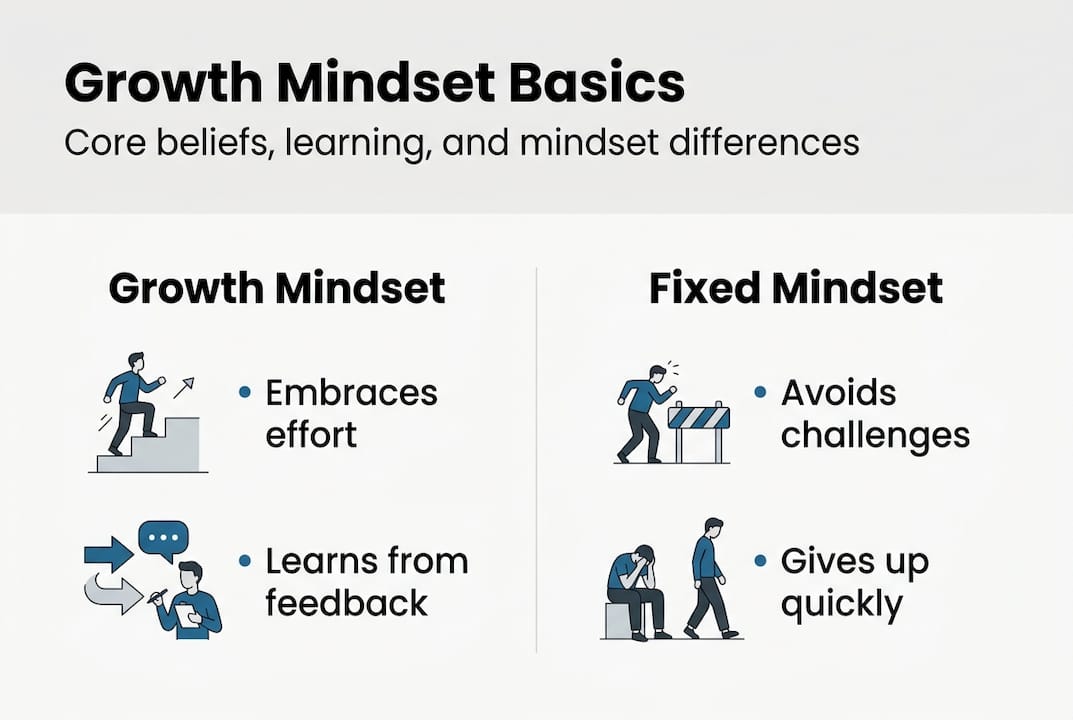
These aren’t just abstract philosophies. They shape how you respond to failure, criticism, and challenge in very real ways. Someone with a fixed mindset avoids difficult tasks to protect their self-image. Someone with a growth mindset sees a hard task as a chance to stretch.
Fixed mindset | Growth mindset |
Avoids challenges | Embraces challenges |
Gives up easily | Persists through setbacks |
Sees effort as pointless | Sees effort as the path forward |
Ignores critical feedback | Learns from feedback |
Threatened by others’ success | Inspired by others’ success |
This contrast shows up everywhere. In school, a student with a fixed mindset might say, “I’m just not a math person.” In the workplace, a professional with a growth mindset asks for feedback after a failed pitch instead of avoiding their manager. Learning a new skill, like a language or instrument, becomes less intimidating when you believe improvement is possible.
Research into neuroplasticity and mindset supports this framework. Your brain physically changes when you learn and practice, which means the belief that you can grow isn’t just optimism. It has a biological basis.
“In a fixed mindset, students believe their basic abilities, their intelligence, their talents, are just fixed traits. They have a certain amount and that’s that.” — Carol Dweck
Key areas where mindset beliefs show up most:
Academic performance and test-taking
Workplace resilience after setbacks
Relationship conflict and repair
Creative work and skill-building
Physical health habits and fitness goals
What research really says: Hype, data, and real effects
Here’s where things get interesting. The popular version of growth mindset often oversells the science. Yes, the theory is grounded in solid research. But the actual effect sizes are smaller than the self-help world would have you believe.
Meta-analyses show small positive effects on academic achievement overall. The effects are stronger for at-risk or disadvantaged learners, and growth mindset mediates only about 3% of the impact that socioeconomic status has on performance. That’s meaningful, but it’s not a miracle.
Population | Effect size | Notes |
General students | Small | Modest average gains |
At-risk learners | Moderate | Stronger, more consistent |
High-achieving students | Minimal | Ceiling effect observed |
Adults in workplace | Emerging | Less studied |
A large-scale meta-analysis of growth mindset interventions found that the highest-quality randomized controlled trials often show null or very small effects. This doesn’t mean growth mindset is useless. It means the context matters enormously.
Some important nuances from the data:
Mindset predicts initial resilience when facing new challenges, not long-term mastery
Interventions work best when paired with actual skill instruction, not delivered alone
US adolescents have shown a declining growth mindset trend in recent years, suggesting environmental factors play a big role
The mediating role of mindset between effort and achievement is real but limited
For your mental well-being, this is actually good news. It means you don’t have to feel like a failure if “just believing” didn’t transform your results. Mindset is one piece of a larger puzzle. Pairing it with science-backed mental health strategies and strong self-care for resilience creates a far more complete picture.
Think of growth mindset as a foundation, not a finished house. It sets the stage for learning, but you still need the tools, the practice, and the support structure to build something lasting.
Common myths and real-life pitfalls
Now that you know what the data shows, it’s equally important to separate common myths from what actually matters about growth mindset.
Myth 1: Just working harder guarantees success. Effort matters, but effort alone isn’t enough. Peer-reviewed research shows a possible U-shaped relationship between mindset and performance, meaning that relentlessly pushing harder without strategy or feedback can actually backfire. Smart effort beats blind effort every time.
Myth 2: Anyone can excel at anything with the right mindset. This is one of the most damaging oversimplifications. Biological limits, access to resources, and structural barriers are real. Mindset can help you navigate them, but it can’t erase them. Pretending otherwise sets people up for self-blame when outcomes don’t match effort.
Myth 3: Mindset is fixed across all situations. You can hold a growth mindset at work and a fixed mindset about your social skills. These beliefs shift by context, and that’s completely normal. The goal isn’t to achieve some permanent enlightened state. It’s to notice where fixed beliefs are limiting you right now.
Myth 4: Praise always builds a growth mindset. Praising effort is helpful. Praising intelligence or talent actually reinforces a fixed mindset, because it ties self-worth to an outcome rather than a process.
“Mindset is not a magic wand. It’s a lens. Change the lens, and you see new options. But you still have to do the work.” — Adapted from growth mindset research
A key pitfall worth naming: overcorrecting into toxic positivity. If you’re always reframing failure as a gift without actually addressing what went wrong, you’re not building resilience. You’re avoiding reality. The difference between a growth mindset and toxic positivity is honest self-assessment. One of the strongest markers of a positive mental attitude is the ability to hold both optimism and realism at the same time.
Pro Tip: When you catch yourself saying “I can’t do this,” add the word “yet.” That single word shift is one of the simplest and most research-supported ways to interrupt a fixed mindset pattern in real time.
How to cultivate a growth mindset: Practical strategies
Understanding the pitfalls lets you put a true growth mindset into practice with concrete strategies tailored for real-life challenges.
The first step is awareness. You can’t shift a belief you haven’t noticed. Start paying attention to your self-talk, especially in moments of failure or frustration. Are you catastrophizing? Comparing yourself to others? Telling yourself you’re “just not that type of person”? These are fixed mindset signals worth catching early.

Research from Frontiers in Education highlights that self-talk shifts, structured reflection, and self-regulated learning all amplify well-being and reduce the impact of fixed mindset slips. In other words, what you say to yourself and how you review your progress both matter.
Here are the most effective everyday practices:
Reframe setbacks in writing. After a failure, write down what happened, what you learned, and what you’d do differently. This turns experience into data.
Seek specific feedback. Vague praise doesn’t help you grow. Ask for concrete input on what worked and what didn’t.
Track micro-progress. Celebrate small wins. Progress is rarely linear, and noticing it keeps motivation alive.
Pair mindset work with skill practice. Belief without action is just wishful thinking. Combine your mindset shifts with deliberate practice in the area you want to grow.
Use movement for personal growth. Physical activity has a proven impact on brain plasticity and emotional regulation, both of which support a growth mindset.
Explore mindset skill development resources to keep building on what you learn here.
Pro Tip: Focus on learning, not perfection. Perfection is a fixed mindset trap dressed up as a high standard. Ask yourself, “What did I learn today?” instead of “Did I do it perfectly?”
Building a growth mindset is a practice, not a destination. Some days you’ll catch the fixed mindset voice early. Other days it’ll win. That’s not failure. That’s the process.
A balanced perspective: The truth most guides don’t tell you
Most growth mindset content falls into one of two traps. Either it oversells the idea as a cure for every struggle, or it dismisses it entirely because the effect sizes aren’t dramatic. Both miss the point.
Here’s what we believe at Life So Well: growth mindset is a genuinely useful tool, but it’s not the whole toolbox. Real emotional resilience comes from knowing when to push, when to pivot, and when to accept that a different approach is needed entirely. That kind of flexibility is actually more powerful than any single mindset.
The most resilient people we see aren’t those who always believe they can do anything. They’re the ones who stay curious, ask good questions, and adjust their strategy when the current one isn’t working. That’s what neuroplasticity and emotional growth actually look like in practice.
Ask yourself honestly: has “try harder” ever been a trap for you? Have you pushed through something that needed a completely different solution? That awareness is the beginning of real growth.
Grow your emotional intelligence journey with Life So Well
A growth mindset is a powerful starting point, but it works best when it’s part of a broader commitment to your emotional and mental well-being. At Life So Well, we’ve built a space where mindset meets practical wellness.

Whether you’re working through emotional patterns, building resilience, or simply looking for grounded, evidence-based guidance, our support for emotional growth section offers resources that go beyond theory. From mindfulness practices to stress management tools, everything is designed to help you apply what you learn in real life. Start exploring what’s possible when you pair a growth mindset with holistic wellness at Life So Well.
Frequently asked questions
Who developed the growth mindset theory?
Stanford psychologist Carol Dweck developed the growth mindset theory after decades of research into motivation and how people respond to challenge and failure.
Can a growth mindset really make you smarter?
It can help you learn more effectively and recover from setbacks, but empirical data shows small effects on achievement overall, with no evidence of a dramatic intelligence boost.
What is the difference between a growth and a fixed mindset?
A growth versus fixed mindset comes down to one core belief: growth mindset sees abilities as developable through effort and learning, while fixed mindset sees them as permanent, unchangeable traits.
How can I recognize a fixed mindset in myself?
Watch for thoughts like “I’m just not good at this” or a habit of avoiding challenges to protect your self-image. These are classic signals that a fixed mindset is running in the background.
Are there situations where a growth mindset doesn’t help?
Yes. When structural barriers, resource gaps, or genuine skill limits are the real issue, mindset alone won’t close the gap. Growth mindset is not a guarantee of success in every context, and recognizing that is part of using it wisely.
Recommended


Comments