
Master a wellness habits workflow for balanced living

You know you should exercise more, eat better, and sleep consistently, but life gets busy and those intentions slip away. Without a clear system, wellness goals feel overwhelming and unsustainable. This guide walks you through creating a practical wellness habits workflow that transforms scattered intentions into automatic routines. You’ll learn how to stack habits onto existing behaviors, start small to avoid burnout, and track progress across multiple life areas. By following these steps, you’ll build emotional resilience, improve mental health, and create the balanced daily living you’ve been seeking.
Table of Contents
Key Takeaways
Point | Details |
Habit stacking method | Attach new wellness actions to existing daily routines to reduce mental friction. |
Core health focus | Concentrating on sleep quality, physical activity, and fruit and vegetable intake yields the biggest well being returns. |
Start with micro habits | Begin with easy one to three minute routines to build momentum before expanding. |
Track progress across domains | Track progress weekly across multiple life domains to stay adaptable and motivated. |
Structured workflow | A clear workflow provides structure and flexibility to overcome time, motivation, and overwhelm barriers. |
Understanding wellness habits and their core components
Wellness habits are intentional actions you take regularly to support your physical, mental, and emotional health. These aren’t random behaviors but strategic choices that compound over time to create lasting change. The challenge is knowing where to focus your limited time and energy for maximum impact on your well-being.
Research reveals that sleep quality, physical activity, and fruit/vegetable intake are the strongest predictors of well-being among young adults, with sleep quality having the greatest impact. This finding simplifies your decision making process dramatically. Instead of trying to overhaul your entire life at once, you can concentrate on these three foundational behaviors that science confirms deliver the biggest returns.
When you improve these core habits simultaneously, they create an additive effect that amplifies your emotional resilience and life balance. Better sleep and recovery gives you energy for physical activity, which improves sleep quality in a positive feedback loop. Meanwhile, proper nutrition for wellness fuels both your workouts and your cognitive function throughout the day.
Most people face predictable barriers when starting wellness habits:
Lack of time in already packed schedules
Uncertainty about which habits to prioritize
Difficulty maintaining motivation after initial enthusiasm fades
Overwhelm from trying to change too many behaviors at once
Absence of a clear system to track progress and adjust strategies
These obstacles aren’t character flaws or signs you’re destined to fail. They’re simply indicators that you need a structured workflow designed specifically to overcome these challenges. The workflow approach addresses each barrier systematically by providing clarity, structure, and flexibility that adapts to your real life circumstances.
Preparing your personalized wellness habits workflow
Habit stacking is your secret weapon for building wellness routines that actually stick. The formula is simple: “After [current habit], I will [new habit].” This method anchors new behaviors to automatic actions you already perform daily, reducing the mental friction that usually derails good intentions. Your brain loves patterns, and habit stacking leverages existing neural pathways to make new behaviors feel natural faster.
Start by identifying 2-3 micro habits rather than attempting a complete lifestyle overhaul. A micro habit takes 1-3 minutes and feels almost too easy to skip. This approach works because it bypasses the resistance your brain creates when facing big, intimidating changes. You’re building momentum and proving to yourself that change is possible before scaling up to more demanding routines.
Your existing daily anchors are goldmines for habit stacking opportunities. Morning coffee, brushing your teeth, commuting to work, lunch breaks, and bedtime routines all serve as reliable triggers for new behaviors. Look at your typical day and identify moments that happen consistently, then attach your wellness habits to these automatic actions.
Pro Tip: Track your progress weekly across five wellness domains (physical, emotional, social, spiritual, and practical) using a simple spreadsheet or journal. This holistic view prevents you from over-optimizing one area while neglecting others, ensuring balanced development that supports true life satisfaction.
Here’s how different habit lengths compare and when to use each version:
Habit Duration | Example Wellness Habit | Best Used When |
1-3 minutes (micro) | 5 deep breaths after waking | Building initial routine, very low energy days |
5-10 minutes (mini) | 10 minute walk after lunch | Moderate energy, time constrained days |
15-30 minutes (standard) | Full yoga session before dinner | Normal energy, scheduled workout days |
30+ minutes (extended) | Long run or comprehensive meal prep | High energy, dedicated wellness time |
The beauty of this system is flexibility. On days when you’re exhausted or overwhelmed, you drop down to micro habits and still maintain your streak. This prevents the all or nothing thinking that destroys most wellness attempts. You’re not failing when you do the 5 minute version instead of the 30 minute version. You’re adapting intelligently to your circumstances while preserving the habit loop that matters most.
Integrating workplace wellness science principles into your personal workflow helps you see connections between professional and personal well-being. The same strategies that improve employee satisfaction, like regular movement breaks and stress management techniques, enhance your daily life outside work too. Understanding the power of movement transforms exercise from a chore into a tool you use strategically throughout your day for energy management and emotional regulation.
Executing and maintaining your workflow for lasting wellness
Implementation turns your carefully designed workflow from theory into daily reality. Here’s your step-by-step execution process:
Start each morning by identifying your energy level on a 1-10 scale to determine which habit versions you’ll use today.
Execute your first habit stack immediately after your morning anchor (coffee, shower, etc.) before decision fatigue sets in.
Check off completed habits in your tracking system to create a visual record of progress.
Use midday as a reset point to stack additional habits onto lunch or afternoon breaks.
Complete your evening habit stack before dinner or bedtime to bookend your day with wellness actions.
Review your daily completion at night and adjust tomorrow’s plan based on what worked and what didn’t.
You will face obstacles. That’s not pessimism, it’s reality. Low energy days happen. Unexpected emergencies disrupt your schedule. Motivation evaporates without warning. The key is having predetermined responses to these predictable challenges rather than improvising in the moment when your willpower is depleted.

When you miss a habit entirely, use the two day rule: never miss twice in a row. One missed day is life happening. Two consecutive missed days is the beginning of a broken habit. Get back on track immediately, even if you only complete the micro version. Your consistency matters more than perfection.
Pro Tip: Set realistic expectations by remembering that sustainable change unfolds gradually. Celebrate when you complete 80% of your planned habits in a week rather than beating yourself up about the 20% you missed. This self-compassion approach actually improves long-term adherence compared to harsh self-criticism.
Combining physical activity with psychological practices delivers superior results. Research shows that exercise paired with mindfulness, yoga, or compassion practices creates stronger well-being improvements than either intervention alone. This finding suggests you should design habit stacks that blend movement with mental health practices whenever possible.
For example, practice mindful breathing during your morning walk, or listen to a guided compassion meditation while stretching. These combinations don’t require extra time but multiply the benefits you receive from the minutes you’re already investing. You’re essentially getting two wellness habits for the time cost of one.
Sustainable change unfolds gradually through consistent small steps, not overnight transformations. Trust the process and give your new habits time to become automatic before judging their effectiveness.
The mindful living techniques you incorporate alongside physical habits create a foundation for emotional resilience that extends far beyond your workout sessions. When you learn to observe your thoughts and sensations without judgment during yoga or breathwork, you develop skills that help you manage emotions effectively in stressful situations throughout your day. The practice becomes portable, available whenever you need it most.
Verifying progress and optimizing your wellness workflow
Weekly check-ins transform vague feelings about your progress into concrete data you can act on. Set aside 15 minutes every Sunday evening to assess your physical, emotional, social, spiritual, and practical wellness domains. This multi-domain tracking approach supports balanced habit growth and prevents you from neglecting important life areas while hyperfocusing on others.
Rate each domain on a 1-10 scale and look for patterns. Is your physical wellness climbing while emotional wellness stagnates? That’s valuable information suggesting you need to add or strengthen habits that address emotional health specifically. Are all domains improving together? That indicates your workflow is well-balanced and sustainable.
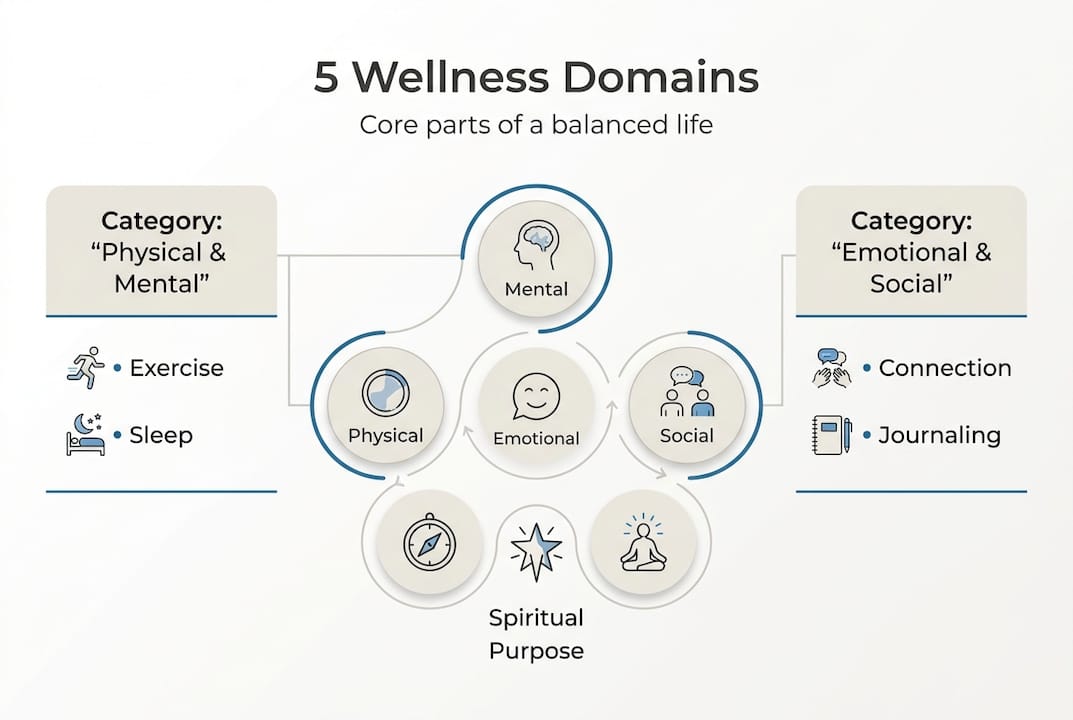
Here’s how to adjust your workflow based on common progress patterns:
Progress Pattern | What It Means | Recommended Adjustment |
All domains improving steadily | Workflow is well-designed and sustainable | Gradually increase habit difficulty or duration |
One domain lagging significantly | Imbalanced focus or missing habit type | Add 1-2 habits specifically targeting weak domain |
Frequent missed habits | Workflow too ambitious or poorly anchored | Reduce to micro habits only, strengthen anchors |
Plateaued progress across domains | Habits no longer challenging enough | Introduce variation or increase intensity |
High completion but low satisfaction | Wrong habits for your actual needs | Reassess goals and replace ineffective habits |
Successful habit adoption shows up in specific, observable ways:
You complete habits without conscious decision making or internal debate
Missing a habit feels uncomfortable or wrong, like skipping tooth brushing
Energy levels remain more stable throughout the day
You handle stressful situations with greater emotional regulation
Physical health markers (sleep quality, energy, mood) show measurable improvement
Social connections feel more satisfying and less draining
When you notice these signs, it’s time to consider adding new habits or increasing the challenge level of existing ones. Your brain has successfully automated the current behaviors, freeing up mental resources for the next layer of growth. This is progress, not a signal that your current habits aren’t working.
Reflecting on your personal balance and emotional resilience improvements provides qualitative verification that complements your quantitative tracking. Ask yourself questions like: Do I feel more capable of handling unexpected challenges? Am I responding to stress with intention rather than reaction? Do I have energy for the people and activities I care about? These subjective assessments reveal benefits that numbers alone might miss.
Tracking tools range from simple to sophisticated. A basic notebook where you check off completed habits works perfectly well for many people. Digital apps offer reminders and data visualization if you prefer technology. The best tool is the one you’ll actually use consistently, so choose based on your personal preferences rather than what seems most impressive.
Journaling alongside your habit tracking adds depth to your data. Spend two minutes after your weekly check-in writing about what felt easy, what challenged you, and what you learned about yourself. These reflections become invaluable when you need to troubleshoot problems or remember why you started this journey during motivation dips.
Monitoring movement and wellness helps you see connections between physical activity and other life domains. You might notice that weeks with consistent exercise correlate with better emotional well-being scores, or that spiritual growth practices improve your resilience during physically demanding periods. These insights guide your optimization efforts far more effectively than generic advice ever could.
Explore Life So Well’s holistic wellness resources
Building a wellness habits workflow is just the beginning of your journey toward balanced, fulfilling daily living. Life So Well offers comprehensive resources designed to support every dimension of your well-being as you refine and expand your practices.

Our platform provides targeted guidance across four key wellness areas. Explore our mind resources for cognitive health strategies, dive into emotions resources for emotional resilience techniques, and discover body wellness resources for physical health optimization. Each section offers practical articles, actionable tips, and evidence-based approaches that complement the workflow you’re building. Visit Life So Well today to access the tools and knowledge that will amplify your wellness journey and help you maintain the balanced life you’re creating.
Frequently asked questions
How do you stick to a wellness habits workflow long-term?
Use habit stacking with flexible micro habits to maintain consistency even when energy is low or schedules get disrupted. Track your progress weekly across multiple wellness domains to notice improvements and identify areas needing adjustment. Celebrate small wins regularly to build motivation and prevent the burnout that comes from perfectionist expectations. Prioritize a balanced approach that addresses physical, emotional, social, spiritual, and practical wellness simultaneously rather than hyperfocusing on one area. Adapt your habits as life circumstances change, treating your workflow as a living system that evolves with you rather than a rigid plan you must follow perfectly.
What are the best habits to include in a wellness workflow?
Focus first on sleep quality, physical activity, and fruit/vegetable intake since these three behaviors are the strongest predictors of overall well-being. Incorporate mindfulness, compassion, or yoga practices alongside physical habits to create the combined benefits that research shows are more effective than either approach alone. Start with manageable micro habits that take 1-3 minutes to complete, building confidence and momentum before scaling up to more demanding routines. Choose habits that align with your personal goals and can be anchored to existing daily behaviors like morning coffee or tooth brushing for easier adoption. Add emotional and social wellness practices alongside physical habits to ensure balanced health development across all life domains.
How does habit stacking work in building wellness habits?
Habit stacking links a new wellness behavior to an existing automatic action using the formula “After [current habit], I will [new habit].” This method leverages your brain’s existing neural pathways to build new habits with significantly less mental effort and faster automaticity than trying to remember standalone behaviors. Starting with just 2-3 small habits prevents the overwhelm that typically derails wellness attempts and builds momentum through early wins. Using consistent daily anchors like morning coffee, tooth brushing, or lunch breaks makes habits easier to remember and complete without relying on willpower. Flexible habit versions allow you to maintain your routine even on low-energy or busy days by dropping down to micro versions rather than skipping entirely.
Recommended
This article is only for information and does not offer medical or other expert advice. If you need medical or other expert advice, please consult doctors and certified experts.


Comments